Grammar
Tenses
Present

Present Simple
Present Continuous
Present Perfect
Present Perfect Continuous
Past
Past Simple
Past Continuous
Past Perfect
Past Perfect Continuous
Future
Future Simple
Future Continuous
Future Perfect
Future Perfect Continuous
Parts Of Speech
Nouns
Countable and uncountable nouns
Verbal nouns
Singular and Plural nouns
Proper nouns
Nouns gender
Nouns definition
Concrete nouns
Abstract nouns
Common nouns
Collective nouns
Definition Of Nouns
Animate and Inanimate nouns
Nouns
Verbs
Stative and dynamic verbs
Finite and nonfinite verbs
To be verbs
Transitive and intransitive verbs
Auxiliary verbs
Modal verbs
Regular and irregular verbs
Action verbs
Verbs
Adverbs
Relative adverbs
Interrogative adverbs
Adverbs of time
Adverbs of place
Adverbs of reason
Adverbs of quantity
Adverbs of manner
Adverbs of frequency
Adverbs of affirmation
Adverbs
Adjectives
Quantitative adjective
Proper adjective
Possessive adjective
Numeral adjective
Interrogative adjective
Distributive adjective
Descriptive adjective
Demonstrative adjective
Pronouns
Subject pronoun
Relative pronoun
Reflexive pronoun
Reciprocal pronoun
Possessive pronoun
Personal pronoun
Interrogative pronoun
Indefinite pronoun
Emphatic pronoun
Distributive pronoun
Demonstrative pronoun
Pronouns
Pre Position
Preposition by function
Time preposition
Reason preposition
Possession preposition
Place preposition
Phrases preposition
Origin preposition
Measure preposition
Direction preposition
Contrast preposition
Agent preposition
Preposition by construction
Simple preposition
Phrase preposition
Double preposition
Compound preposition
prepositions
Conjunctions
Subordinating conjunction
Correlative conjunction
Coordinating conjunction
Conjunctive adverbs
conjunctions
Interjections
Express calling interjection
Phrases
Sentences
Grammar Rules
Passive and Active
Preference
Requests and offers
wishes
Be used to
Some and any
Could have done
Describing people
Giving advices
Possession
Comparative and superlative
Giving Reason
Making Suggestions
Apologizing
Forming questions
Since and for
Directions
Obligation
Adverbials
invitation
Articles
Imaginary condition
Zero conditional
First conditional
Second conditional
Third conditional
Reported speech
Demonstratives
Determiners
Linguistics
Phonetics
Phonology
Linguistics fields
Syntax
Morphology
Semantics
pragmatics
History
Writing
Grammar
Phonetics and Phonology
Semiotics
Reading Comprehension
Elementary
Intermediate
Advanced
Teaching Methods
Teaching Strategies
Assessment

Phrasing and intonation
 المؤلف:
Richard Ogden
المؤلف:
Richard Ogden
 المصدر:
An Introduction to English Phonetics
المصدر:
An Introduction to English Phonetics
 الجزء والصفحة:
46-4
الجزء والصفحة:
46-4
 15-6-2022
 1167
1167




+
-
20
Phrasing and intonation
All languages use changes in pitch to handle some aspect of meaning. In English, changes in pitch are associated with sentence- or utterance-level meanings and not e.g. word meanings. Intonation is the linguistic use of particular f0 contours in the production of speech. These contours can be described using labels that refer to their shapes such as ‘fall’ ([]), ‘rise’ ([/]), ‘fall–rise’ ([/]), ‘rise–fall’ ([/]), ‘level’ [`], sometimes accompanied by a reference to where in the speaker’s overall range the contour is: ‘a high fall’, ‘a fall to low’, ‘a low rise’.
In English utterances, the main stressed item of an utterance carries an intonation contour. This means that pitch movement starts on the stressed item and carries on over any subsequent syllables. Other stressbearing syllables may, but need not, carry an intonation contour. The placement of contours in English depends on the context.
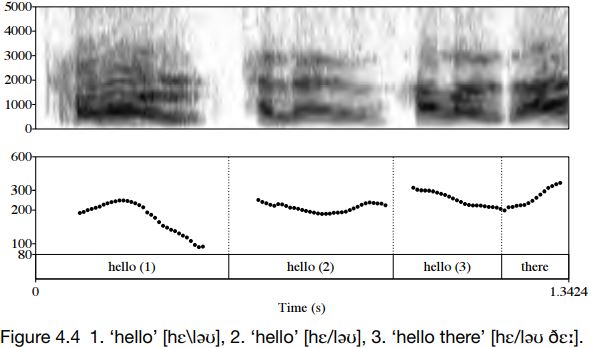
Figure 4.4 shows f0 traces for three utterances: ‘hello’ [hεləυ], ‘hello’ [hεləυ] and ‘hello there’ [hεləυ ðε:]. The difference between the falling and rising contours should be visible enough. (It is safe to ignore the smaller movements of f0 on the unstressed syllables: they are not auditorily prominent in the way that movements on stressed syllables are.) In ‘hello (3)’, the f0 contour is the same as in ‘hello (2)’, but it is distributed over more material.
Here are two speakers assessing a third person:
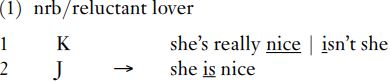
Our focus of interest is line 2, ‘she is nice’. In the first line, K assesses another person as ‘really nice’, and invites J to agree with her (‘isn’t she’). J responds by repeating K’s words: ‘she is nice’. In English, when words are repeated, it is normal for the stress to shift to a different word from the first time round: the ‘nice’ in line 2 is ‘deaccented’. The main stresses in the utterances are marked with underlining.
Now let us imagine different intonation contours here. With a falling intonation contour (‘she is nice’), the pitch would be high on ‘is’, and fall to low at the end of ‘nice’. Most English speakers would say that line 2 produced this way expresses straightforward agreement. If the contour is different, then the meaning is different. If line 2 had a fall followed by a rise (‘she /is nice’), where the pitch is high on ‘is’, but then falls and is low at the start of ‘nice’, rising up again at the end of ‘nice’, then most English speakers would say that the next word is likely to be ‘but’. A fall–rise intonation contour in this context usually says: there is an upcoming disagreement.
In fact, this is how the conversation actually went:
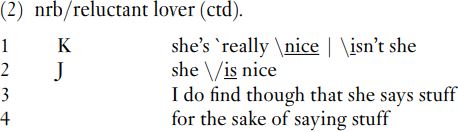
In lines 3–4, J qualifies her agreement that the other person is ‘nice’. This illustrates that in English intonation handles utterance-level meanings: the fall vs. fall–rise contours here mark different types of agreement.
Here are two examples of the word ‘yes’, both located after an assessment. They differ in intonation, loudness, pitch range, and in their location relative to the previous turn at talk; and they also differ in the meanings they convey.
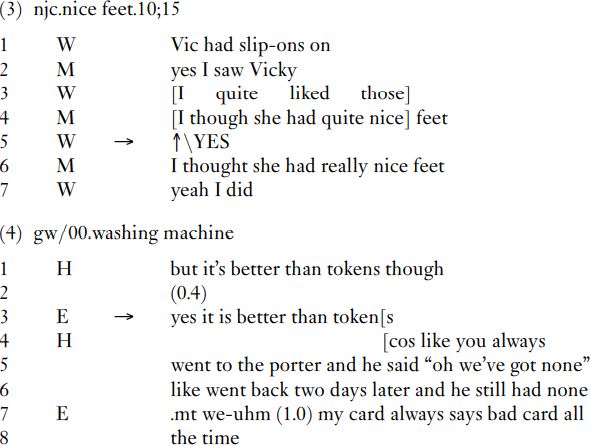
In (3), Marion and Wendy are discussing a character from a soap opera. Marion says she thought she had ‘quite nice feet’, and Wendy agrees with her. She does her agreement in line 5 almost immediately after Marion has assessed Vicky’s feet. She does her agreement loud (represented with capital letters here) and with quite high pitch (represented by [↑]).
The second case, ‘washing machine’, also has a ‘yes’, in line 3. In this fragment, Elizabeth and Helen are discussing the system used to pay for the launderette at college, which has changed from tokens to a smart card. Helen says the new system is ‘better than tokens though’. Elizabeth agrees with this, but her agreement comes late (almost half a second later). Agreeing late weakens the sense of agreement; notice that Helen comes in and explains her assessment of the new system as ‘better’, and the next thing Elizabeth does is to find a reason why the new system is not very good (lines 7–8). So the ‘yes’ here is not whole-hearted, especially in comparison with the ‘yes’ of the first example. Perhaps unsurprisingly, the strength of agreement is audible too: the ‘yes’ in line 3 of the ‘washing machine’ extract is quiet, low pitched, and slow – a direct contrast with the ‘yes’ in line 5 of the ‘nice feet’ extract.
Here, then, we have two instances where ‘yes’ is produced, but the intonation, along with other things, affects the ‘meaning’ of the ‘yes’, making it stronger and more affirmative, or weaker and prefacing a disagreement.
Phrasing and intonation give speakers clues about the syntax that organizes words into structures. This is one of the main interfaces between phonetics and syntax and semantics. Talk is chunked up into phrases, whose boundaries reflect major syntactic boundaries. The symbols [| ||] mark minor and major intonational phrase boundaries. Phrases have some or all of the following characteristics (roughly):
• At the start: speeding up, re-setting of pitch
• At the end: slowing down, quieter, near the bottom or top of the speaker’s pitch range
• A pause before or after
• Congruence with syntactic or pragmatic boundaries
Take the following sentence:
(5) We didn’t go to the museum because it was raining.
Did we go or not? If the sentence is spoken on a monotone, it is not possible to tell. But if an intonation contour is placed on the sentence, then two different meanings are possible:

In the first one, there is one phrase and the last word has a falling + rising intonation contour on it. It means: we did go to the museum, but for some other reason than the fact that it was raining. In the second one, there are two phrases, with a slowing down at the end of ‘museum’, and two falling contours, one on ‘didn’t’, the other on ‘raining’. This means: we did not go to the museum and the reason is that it was raining.
 الاكثر قراءة في Phonetics
 اخر الاخبار
اخبار العتبة العباسية المقدسة

الآخبار الصحية


مواضيع ذات صلة
 قسم الشؤون الفكرية يصدر كتاباً يوثق تاريخ السدانة في العتبة العباسية المقدسة
 "المهمة".. إصدار قصصي يوثّق القصص الفائزة في مسابقة فتوى الدفاع المقدسة للقصة القصيرة
 (نوافذ).. إصدار أدبي يوثق القصص الفائزة في مسابقة الإمام العسكري (عليه السلام)