تاريخ الرياضيات

الاعداد و نظريتها
تاريخ التحليل
تار يخ الجبر
الهندسة و التبلوجي
الرياضيات في الحضارات المختلفة
العربية
اليونانية
البابلية
الصينية
المايا
المصرية
الهندية
الرياضيات المتقطعة
المنطق
اسس الرياضيات
فلسفة الرياضيات
مواضيع عامة في المنطق
الجبر
الجبر الخطي
الجبر المجرد
الجبر البولياني
مواضيع عامة في الجبر
الضبابية
نظرية المجموعات
نظرية الزمر
نظرية الحلقات والحقول
نظرية الاعداد
نظرية الفئات
حساب المتجهات
المتتاليات-المتسلسلات
المصفوفات و نظريتها
المثلثات
الهندسة
الهندسة المستوية
الهندسة غير المستوية
مواضيع عامة في الهندسة
التفاضل و التكامل
المعادلات التفاضلية و التكاملية
معادلات تفاضلية
معادلات تكاملية
مواضيع عامة في المعادلات
التحليل
التحليل العددي
التحليل العقدي
التحليل الدالي
مواضيع عامة في التحليل
التحليل الحقيقي
التبلوجيا
نظرية الالعاب
الاحتمالات و الاحصاء
نظرية التحكم
بحوث العمليات
نظرية الكم
الشفرات
الرياضيات التطبيقية
نظريات ومبرهنات
علماء الرياضيات
500AD
500-1499
1000to1499
1500to1599
1600to1649
1650to1699
1700to1749
1750to1779
1780to1799
1800to1819
1820to1829
1830to1839
1840to1849
1850to1859
1860to1864
1865to1869
1870to1874
1875to1879
1880to1884
1885to1889
1890to1894
1895to1899
1900to1904
1905to1909
1910to1914
1915to1919
1920to1924
1925to1929
1930to1939
1940to the present
علماء الرياضيات
الرياضيات في العلوم الاخرى
بحوث و اطاريح جامعية
هل تعلم
طرائق التدريس
الرياضيات العامة
نظرية البيان

Chinese Remainder Theorem
 المؤلف:
Flannery, S. and Flannery, D
المؤلف:
Flannery, S. and Flannery, D
 المصدر:
Code: A Mathematical Journey. London: Profile Books
المصدر:
Code: A Mathematical Journey. London: Profile Books
 الجزء والصفحة:
...
الجزء والصفحة:
...
 5-1-2020
 1141
1141




+
-
20
Chinese Remainder Theorem
Let  and
and  be positive integers which are relatively prime and let
  and
and  be any two integers. Then there is an integer
  such that
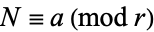 |
(1) |
and
 |
(2) |
Moreover,  is uniquely determined modulo
  . An equivalent statement is that if
 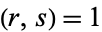 , then every pair of residue classes modulo
  and
and  corresponds to a simple residue class modulo
  .
.
The Chinese remainder theorem is implemented in the Wolfram Language as ChineseRemainder[{" src="http://mathworld.wolfram.com/images/equations/ChineseRemainderTheorem/Inline12.gif" style="height:15px; width:5px" />a1, a2, ...
}" src="http://mathworld.wolfram.com/images/equations/ChineseRemainderTheorem/Inline13.gif" style="height:15px; width:5px" />
{" src="http://mathworld.wolfram.com/images/equations/ChineseRemainderTheorem/Inline14.gif" style="height:15px; width:5px" />m1, m2, ...
}" src="http://mathworld.wolfram.com/images/equations/ChineseRemainderTheorem/Inline15.gif" style="height:15px; width:5px" />]. The Chinese remainder theorem is also implemented indirectly using Reduce in with a domain specification of Integers.
The theorem can also be generalized as follows. Given a set of simultaneous congruences
 |
(3) |
for  , ...,
  and for which the
  are pairwise relatively prime, the solution of the set of congruences is
 |
(4) |
where
 |
(5) |
and the  are determined from
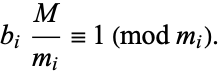 |
(6) |
REFERENCES:
Flannery, S. and Flannery, D. In Code: A Mathematical Journey. London: Profile Books, pp. 123-125, 2000.
Ireland, K. and Rosen, M. "The Chinese Remainder Theorem." §3.4 in A Classical Introduction to Modern Number Theory, 2nd ed. New York: Springer-Verlag, pp. 34-38, 1990.
Séroul, R. "The Chinese Remainder Theorem." §2.6 in Programming for Mathematicians. Berlin: Springer-Verlag, pp. 12-14, 2000.
Uspensky, J. V. and Heaslet, M. A. Elementary Number Theory. New York: McGraw-Hill, pp. 189-191, 1939.
Wagon, S. "The Chinese Remainder Theorem." §8.4 in Mathematica in Action. New York: W. H. Freeman, pp. 260-263, 1991.
 الاكثر قراءة في نظرية الاعداد
 اخر الاخبار
اخبار العتبة العباسية المقدسة

الآخبار الصحية


 قسم الشؤون الفكرية يصدر كتاباً يوثق تاريخ السدانة في العتبة العباسية المقدسة
 "المهمة".. إصدار قصصي يوثّق القصص الفائزة في مسابقة فتوى الدفاع المقدسة للقصة القصيرة
 (نوافذ).. إصدار أدبي يوثق القصص الفائزة في مسابقة الإمام العسكري (عليه السلام)