الوضع الليلي


 10:52:3
  2025-07-22
  1824
1824
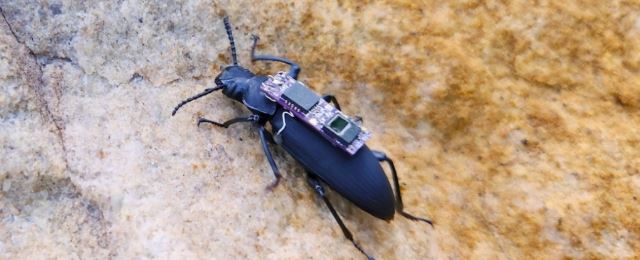
Disaster victims trapped beneath the rubble of a collapsed building or mine may one day be rescued by a tiny and unlikely savior: a beetle with a backpack.
Researchers have made major strides in cyborg technology, creating a breed of cyborg beetles that can climb walls, obstacles, and sloped surfaces while being remotely guided by a video game controller.
Called "ZoBorgs," the cyborg beetles are a collaborative effort between The University of Queensland and the University of New South Wales, both in Australia, and Singapore's Nanyang Technological University.
To imbue their darkling beetles (Zophobas morio) with remote control, the researchers equipped them with a microchip backpack that sends electrical signals to the beetles' antennae or forewings (elytra), prompting them to move in different directions.
Darkling beetles are also known as 'superworms' for the worm-like form of their larvae. These creatures may help the world in multiple ways. Culinarily, they're a rich source of fatty acids and protein, commonly consumed in countries like Mexico and Thailand.
The larvae also love dining on one of the world's most prevalent plastics, polystyrene, which is used to make common conveniences like packing materials and disposable cutlery. This is not good for the beetles, but copying how they digest the substance could help us tackle the plastic waste problem.
At up to 32 millimeters (1.26 inches) in body length and about 8 millimeters (0.3 inches) in height, darkling beetles are small and nimble, possessing natural gifts that allow them to maneuver where robots cannot: within the tight confines of dense, jumbled rubble.
Featured in Advanced Science, the new study harnesses the beetles' natural gifts and "adds programmable controls that allow for precise directional guidance, without affecting the lifespan of the beetle," says engineer Thang Vo-Doan of the School of Mechanical and Mining Engineering at The University of Queensland.
These programmable controls are transmitted via a beetle-backpack with electrodes that act like electrical reins. Stimulating the antennae causes the beetle to turn, decelerate, or walk backwards. Stimulating both elytra causes acceleration or forward walking, while stimulating a single elytron causes sideways movement.
As a result, the ZoBorgs can cross obstacles equal to their body height with a success rate of 92 percent. They can also move from horizontal to vertical surfaces with a 71.2 percent success rate – a rate unmatched by previous cyborg insects or robots.
Lachlan Fitzgerald, an engineer at The University of Queensland, explains that while "robots at this scale have made strides in locomotion, the transition from horizontal surfaces to walls remains a formidable challenge for them." But not so for the ZoBorgs.
Plus, using beetles means that researchers do not have to design actuators, sensors, or control systems – the beetles are already naturally equipped by many millions of years of evolutionary adaptations. These climbing adaptations include flexible, adhesive footpads, gripping claws, and rigid but agile body structures.
In combination with their antennae, insects use sensors in their legs and mechanoreceptors in their exoskeletons to sense physical stimuli, such as surface textures and vibrations.
Future advances may focus on improving the beetles' climbing ability and autonomy by incorporating an inertial measurement unit (IMU) that provides real-time, non-visual data like acceleration and other forces.
The addition of a compact, lightweight visual camera can further boost control mechanisms, and will be necessary for identifying trapped individuals in search and rescue situations. Finally, cyborg advances described here could inspire innovations in robotics, such as the incorporation of beetle-like feelers to improve robots' navigational abilities.
Notably, scientists maintained ethical practices to ensure the beetles’ well-being. Compared to other animals used in research, the beetles lived in relatively ritzy conditions, sleeping on wheat-bran bedding and eating fresh apple slices. Following the experiments, they received care for the remainder of their three-month lifespans.
This study demonstrates that cyborg science is making essential strides. It may not yet be the robotic organs promised by science fiction, but a cyborg beetle may be just as likely to save lives.
Reality Of Islam |
|

A new gener
Building a
Now in spac
NASA’
 9:3:43
2018-11-05
9:3:43
2018-11-05
10 benefits of Marriage in Islam
7:5:22
2019-04-08
benefits of reciting surat yunus, hud &
9:45:7
2018-12-24
advantages & disadvantages of divorce
11:35:12
2018-06-10
6:0:51
2018-10-16
5:57:34
2023-03-18
5:58:12
2021-12-18
a hero waters thirsty wild animals
9:4:9
2022-01-06
3:18:29
2022-12-24
al-hussain (peace be upon him)
10:18:1
2022-09-21
7:45:39
2018-06-21
2:11:12
2022-10-15
5:41:46
2023-03-18
| LATEST |
 HOME
HOME