Electron-capture detector (ECD)
The early form of this detector consists of a small chamber with a pair of electrodes and a radioactive source, usually 63Ni, placed close to the cathode to ionise the carrier gas. Potential applied to the electrodes produces a steady back ground current. There is an interaction with the electrons emitted from the 63Ni source with the carrier gas to produce ‘low-energy’ electrons. These electrons then interact with electronegative solutes (Fig. 1). The response of the detector is therefore a loss of signal rather than an increase, as is given by most other detectors. Although the ECD can be polarised from a suit able low-voltage direct-current supply, it is more sensitive when a pulsed power supply is used, and in modern detectors the polarising pulses are modulated to maintain a constant current. A voltage dependent on the modulation frequency is generated as the output signal. Additional carrier gas is necessary, even with packed columns, to obtain a flow of at least 60 mL/min to purge the detector adequately and avoid peak broadening and distortion. Sensitivity can also be improved dramatically by raising the operating temperature of the detector, and decreasing the makeup gas flow.
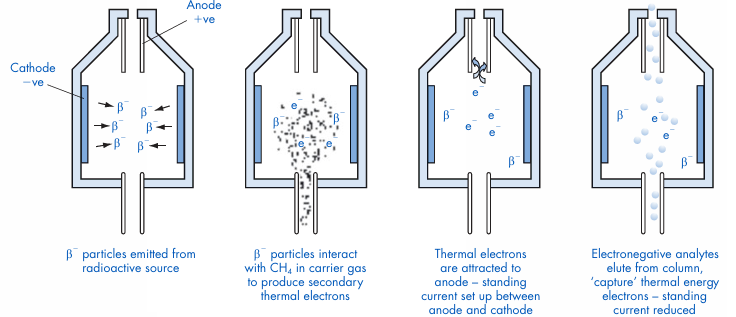
Figure 1 Schematic of operation of electron capture detector (ECD), simplified to note the most important principles of how the detector operates.
The ECD is a selective detector with a very high sensitivity to compounds that have a high affinity for electrons; for many compounds, the sensitivity of the ECD often exceeds that of MS, and sometimes even that of the NPD. Compounds that contain a halogen, nitro group or carbonyl group are detected at concentrations of 0.1–10 pg, 1–100 pg and 0.1–1 ng, respectively. This makes it very useful for compounds such as the benzodiazepines or halogenated pesticides and herbicides. Alternatively, the great sensitivity of the detector may be utilised by preparing derivatives with halogenated reagents, such as trifluoroacetic, heptafluorobutyric or pentafluoro propionic (PFP) anhydrides. Linearity (at best only two or three orders of magnitude) is a limiting factor for quantitative analysis. In older models, the addition of a small amount of quench gas, such as methane, improves stability and linearity, and is essential if argon or helium carrier gas is used. Newer models can be operated successfully with helium as both carrier and detector gas. The ECD, because of its high sensitivity, can be contam inated easily: an impure cylinder of gas can damage a detector beyond repair in a matter of only a few hours. The use of electrophilic solvents as dissolution agents for solutes should be avoided. Cleaning is difficult, although some material can be removed by heating the detector to its maximum operating temperature overnight, and the injection of water in 100 μL aliquots through an empty glass column can also help. However, if contamination is avoided, it is virtually maintenance-free. The radioactive source requires special handling procedures that may be subject to regulation. More recently, it has been shown that this detector can work with greater sensitivity and operate over an increased linear range using a helium plasma in place of the radioactive source.








