Syntactic Structure and Answer hood Conditions
In general, a multiple interrogative can be answered either with a single pair (SP) or with a list (typically a pair list, PL). More specifically, certain multiple interrogative constructions may allow both of these answer types as appropriate, others may be expected to be answered only by an SP, or only by a PL. I demonstrate now that the distribution of the SP and PL interpretations across the constructions identified above is straight forwardly derived on the basis of the structural descriptions I have posited.
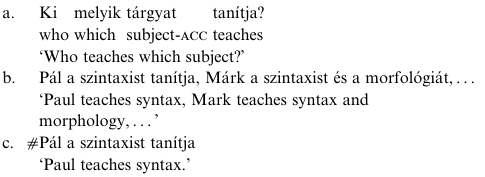
Here I will adopt Higginbotham and May’s (1981) proposal, also maintained by Barss (2000), that Absorption is a necessary and sufficient condition for a PL reading to obtain. Absorption is a rule of the syntax semantics interface that requires the relevant A ¯-elements to be structurally adjacent. Practically, this entails that if Absorption is to take place, the wh-phrases must raise to the same FocP, the checking position of wh operators. If correct, this assumption directly explains a prominent fact about Hungarian MF questions: they can only receive PL answers, not SP answers. For instance, a question like (1a), can be answered with a list, as in (1b) (= (4b)), but not with a single pair of a person and a subject taught (1c).
(1)
English-typenonfocused questions do not have the surface in-situ and the preverbal wh-phrase in structurally adjacent positions; hence, only an SP reading is expected. On the other hand, English-typefocused questions do have the surface in-situ wh-element structurally adjacent to the preverbal wh-phrase in covert syntax;10 hence, a PL reading is predicted. That is, for the English-type surface pattern it is predicted that either an SP or a PL reading should be available. All sources on Hungarian describe English-type questions as allowing an SP reading. However, it has gone unnoticed that they also license a PL answer.
(2)
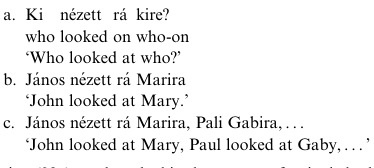
Question (2a) can be asked in the context of a single looking event (2b), but also in the context of attempting to reconstruct what looking events occurred during a group game that is based on silent eye-gestures (2c). What is remarkable is that although both MF questions and (2a)-type (i.e., English-typefocused) questions can be answered with a list, this list strictly must involve individuals as second members of the pairs (nth members of the n-tuples) in the case of (2a)-type (i.e., English-typefocused) interrogatives (‘‘matching questions’’), whereas an answer to MF questions can also have sets of individuals as second (nth) members (see, e.g., (1b)). Thus, (29) is not felicitous as an answer to (2a).
(3)

In fact, the analysis I have proposed already explains this restriction with respect to PL answers to English-type questions. English-type questions involve the application of a choice function variable to a wh-pronoun. In English-typefocused questions (like (2a)), the (determiner of the) in-situ wh-item undergoes Absorption with the (determiner of the) preverbal wh-operator, hence the list reading. Given that choice functions by definition output individuals only, the list will contain individuals as second members. This is suggestive evidence of the role played by choice functions in such ‘‘matching’’ questions.
A further correct consequence of the account developed here is the following. Given that Absorption requires movement of the in-situ wh phrase in English-type questions, in contexts where this movement is not conceivable—for instance, because of locality restrictions—it is predicted that such English-type questions can expect only an SP answer, not a PL answer. Thus, (4a), which involves an island, should allow only an SP answer. Similarly, (4b), involving a quantificational intervener between the preverbal and the in-situ wh-phrases, is expected to be incompatible with a PL reading. These predictions are indeed verified.
(4)
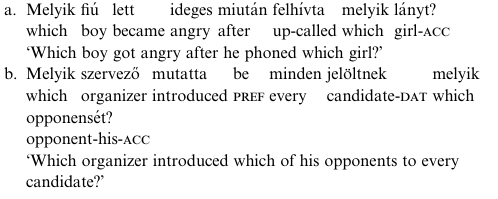
(5)
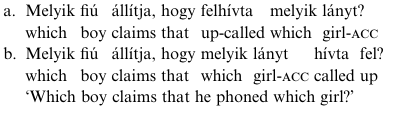
I have established that English-typenonfocused questions must receive an SP answer. This correctly holds of (5a) as well. On the other hand, I have demonstrated that English-typefocused questions may also receive a PL answer (of a restricted kind). On the present account, (5b) is an English typefocused question. However, given that the second wh-element moves to FocP of the lower clause, no structural adjacency obtains; hence, in turn, Absorption cannot apply. Thus, for (5b) only an SP reading is generated—once again, the right prediction: (5b) is indeed incompatible with a PL answer.
On the other hand, if the second wh-element in (5) can both be assigned [foc] and associated with the preverbal wh-phrase in the matrix clause, then a list reading is expected to reappear, exceptionally. The relevant case is (6).
(6)
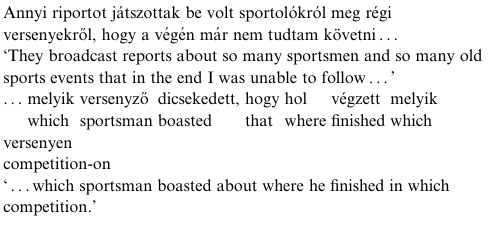
Here the matrix verb embeds an interrogative itself. This interrogative clause has its own wh-operator hol ‘where’ in Spec,FocP. This allows the in-situ wh-phrase to be construed as [foc], which then can be syn tactically associated with the wh-operator of the matrix clause (as is char acteristic of such ‘‘wh-triangle’’ situations), via covert movement. In this case, a PL interpretation is predicted to be induced by the matrix and the in-situ wh-phrases. Indeed, this is correct: (6) can be answered as in (7).
(7)
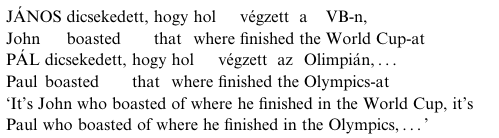
Let us take stock of the results of this section. Relying on H&M’s approach to pair-list readings, I exploited the findings regarding the proper structural description of multiple wh-questions, their focus structure, and the application of choice functions to systematically derive answerhood conditions for the three discovered syntactic patterns of this type of question. I showed that the account of the answerhood conditions naturally and correctly extends to some more complex types of multiple wh-interrogatives as well.
In the remainder of the chapter, I demonstrate that the treatment of the PL/SP distinction defended here can be supported in a typological context.








