What’s the Use of Linguistics? Pre-Service English Teachers’ Beliefs towards Language Use and Variation
THE RESULTS
Are there significant differences between the two groups?
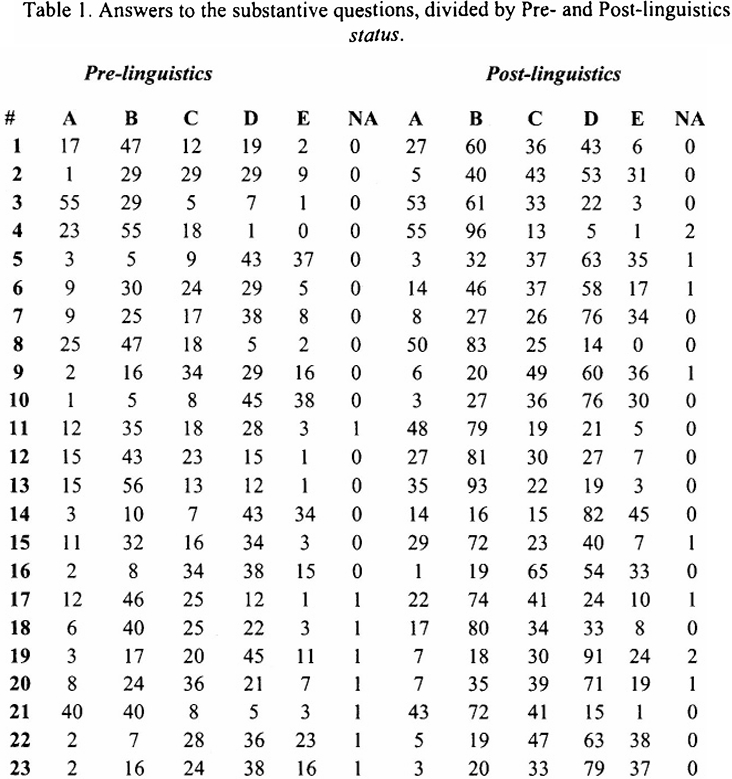
There were indeed significant differences in the responses to some of the questions, but not others.iii The two groups, pre- and post-linguistics, had different patterns of answers to questions 3, 5, 7, 10, 11, 15, 20, and 21. Questions 3, 5, 7,10, and 20 all concerns attitudes toward or elements of AAVE. Question 21 concerns a feature found in AAVE but also present in other American dialects. Question 11 focuses on the use of grammar. Question 15 addresses the ability of adults to learn a foreign language. We hypothesize the differences in responses came about as a result of the linguistics class(es) taken.
The central result reflected in our data is the significant shift in attitude of our students toward AAVE and its forms. This is in no way surprising, since the selection of the questions was dictated in part by our finding in the pilot studies that precisely in these areas there were the most significant attitudinal shifts. Two groups of questions examined attitudes toward AAVE: questions 7, 17, 18, 20, and 23 directly mentioned AAVE, whereas questions 3, 5, 10, and 21 addressed grammatical features present in AAVE, without mentioning AAVE. Questions 12 and 14 addressed features present in AAVE but not exclusively. Appendix A lists all 27 questions.
The most blunt question (20) “AAVE has a faulty grammar system” shows the greatest attitudinal shift: the conflated agreement figures (i.e., “agree” plus “strongly agree”) diminish by about 8.5 percent but the disagreements are augmented by nearly 23.5 percent. Similarly, question (7) “AAVE is a misuse of Standard English” sees a decrease of agreements by more than 14.5 percent and an increase of disagreements by more than 16.5 percent. Questions 17, 18, and 23 have similar results, but with smaller shifts, however all in a direction favorable to AAVE.
When we move to the grammatical forms, we find the same pattern: in question (5), which features the aspectual marker been, the students who find it acceptable increase by about 12 percent, and those who find it unacceptable decrease by about 25 percent. Question (10), on the aspectual marker be, shows almost identical results: an increase of more than 11 percent of acceptable judgments and a decrease of unacceptability of about 24 percent. Questions (3) and (21) also show similar patterns, with lower percentages.
Interestingly, while question (12), on the acceptability of the object form of the pronoun in subject position (it’s me), shows a limited shift toward acceptability (7 percent), question (14), on the double negative, shows about 3 percent more students giving the “logical” interpretation of the double negative (as canceling one another), rather than the natural (reinforcing), thus showing a worsening of attitudes.
From these data we conclude that even a limited exposure to linguistics and sociolinguistics (only one semester/course) effects significant changes in the reported attitudes of the students, as far as AAVE goes. The fact that the changes are about the same in percentage in the questions in which AAVE is mentioned directly as in those that concern grammatical features of AAVE but in which AAVE is not mentioned seems to imply that the students are not being “politically correct” and simply aping political views that they would assume are standard in academe. The hypothesis that our students can see through the grammatical questions and interpret them as veiled questions on AAVE to which they would then provide “politically correct” answers strains credulity (and fails to explain why double negatives and object pronouns are not also treated “politically”).
This result strikes us as highly significant, since affecting up to 25 percent of our students’ attitudes toward AAVE must surely qualify as an important educational result. One may wonder why we are not addressing the issue of learning (after all, that’s what classes are for). This is due to two main reasons. The first is that attitude modification does not correlate in an obvious way to learning. Specifically, while it is impossible to have attitude modification without learning, it is perfectly plausible to have learning without attitude modification (after all, a Democrat can probably describe the Republican platform without changing party affiliation). The second is that, of course, learning is assessed directly by the testing and grading that takes place regularly in the classroom. Our students are assessed as having learned at least a little when they receive a grade of C or better.
iii For those uncomfortable with statistics, let us point out that we tested statistically the significance of the differences between the two groups, but we chose to report the data in terms of percentages, which are grasped more intuitively. In other words, while it is nice to confirm your results statistically, good work can be done also without the safety net of statistical significance measures.








