Grammar
Tenses
Present

Present Simple
Present Continuous
Present Perfect
Present Perfect Continuous
Past
Past Simple
Past Continuous
Past Perfect
Past Perfect Continuous
Future
Future Simple
Future Continuous
Future Perfect
Future Perfect Continuous
Parts Of Speech
Nouns
Countable and uncountable nouns
Verbal nouns
Singular and Plural nouns
Proper nouns
Nouns gender
Nouns definition
Concrete nouns
Abstract nouns
Common nouns
Collective nouns
Definition Of Nouns
Animate and Inanimate nouns
Nouns
Verbs
Stative and dynamic verbs
Finite and nonfinite verbs
To be verbs
Transitive and intransitive verbs
Auxiliary verbs
Modal verbs
Regular and irregular verbs
Action verbs
Verbs
Adverbs
Relative adverbs
Interrogative adverbs
Adverbs of time
Adverbs of place
Adverbs of reason
Adverbs of quantity
Adverbs of manner
Adverbs of frequency
Adverbs of affirmation
Adverbs
Adjectives
Quantitative adjective
Proper adjective
Possessive adjective
Numeral adjective
Interrogative adjective
Distributive adjective
Descriptive adjective
Demonstrative adjective
Pronouns
Subject pronoun
Relative pronoun
Reflexive pronoun
Reciprocal pronoun
Possessive pronoun
Personal pronoun
Interrogative pronoun
Indefinite pronoun
Emphatic pronoun
Distributive pronoun
Demonstrative pronoun
Pronouns
Pre Position
Preposition by function
Time preposition
Reason preposition
Possession preposition
Place preposition
Phrases preposition
Origin preposition
Measure preposition
Direction preposition
Contrast preposition
Agent preposition
Preposition by construction
Simple preposition
Phrase preposition
Double preposition
Compound preposition
prepositions
Conjunctions
Subordinating conjunction
Correlative conjunction
Coordinating conjunction
Conjunctive adverbs
conjunctions
Interjections
Express calling interjection
Phrases
Sentences
Clauses
Part of Speech
Grammar Rules
Passive and Active
Preference
Requests and offers
wishes
Be used to
Some and any
Could have done
Describing people
Giving advices
Possession
Comparative and superlative
Giving Reason
Making Suggestions
Apologizing
Forming questions
Since and for
Directions
Obligation
Adverbials
invitation
Articles
Imaginary condition
Zero conditional
First conditional
Second conditional
Third conditional
Reported speech
Demonstratives
Determiners
Direct and Indirect speech
Linguistics
Phonetics
Phonology
Linguistics fields
Syntax
Morphology
Semantics
pragmatics
History
Writing
Grammar
Phonetics and Phonology
Semiotics
Reading Comprehension
Elementary
Intermediate
Advanced
Teaching Methods
Teaching Strategies
Assessment

The final stages
 المؤلف:
Bernd Heine and Tania Kuteva
المؤلف:
Bernd Heine and Tania Kuteva
 المصدر:
The Genesis of Grammar
المصدر:
The Genesis of Grammar
 الجزء والصفحة:
P98-C2
الجزء والصفحة:
P98-C2
 2026-02-27
 27
27




+
-
20
The final stages
The developments sketched in the previous section by no means constitute the endpoint of grammaticalization; rather, as has been demonstrated independently in many works, the process may continue until both the meaning and the phonetic substance of the item undergoing grammaticalization are lost. For example, when definite articles a rise out of demonstrative attributes in accordance with the Demonstrative > definite article pathway, they may further undergo extension, spreading from definite to all specific nouns (= ‘‘Stage-II articles’’), and finally their use can be generalized to occur with virtually all nouns, except, for example, for some generic uses, becoming an obligatory appendage of nouns, thereby acquiring the status of signaling nominality (= ‘‘Stage-III articles’’; Greenberg 1978, 1991). In a similar fashion, when a tense marker arises, this need not be the end of grammaticalization. Tense markers may develop further into markers of epistemic modality and/or they may assume subordinating functions (see, e.g., “Assumptions” (2d)).
The following example, being a special instance of the Verb > complementizer pathway, illustrates what may happen in the final stages of the process. The more a verb in combination with another verb loses in meaning content, the more it tends to merge with the other verb, and in the end the two may lexicalize into a new verb. In the Saharan languages of the Nilo-Saharan family, a verb for ‘say’ has been added productively to other verbs, adjectives, and nouns serving as its complements, one of its functions being to derive verbs from other word categories.1 In the course of this process, the ‘say’-verb has merged with its complement to the extent that it has lost its meaning entirely, the result being a new verb. The following example from the Nigerian Kanuri illustrates the various stages of development. Sentence (50a) shows the lexical use of the verb, (50b) that of ‘say’ as an element deriving (inchoative) verbs from adjectives (in this case, ku̒rà ‘big’), and (50c) illustrates the use of ‘say’ as a semantically empty inflectional appendage of a verb, that is, its erstwhile complement.
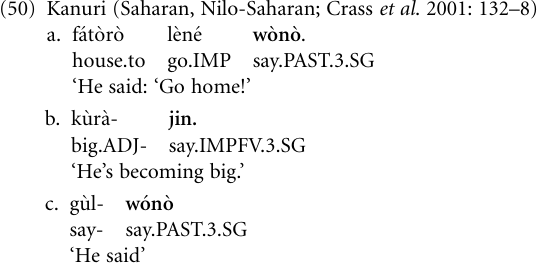
The erstwhile verb has undergone massive erosion, surviving in most cases solely as an alveolar nasal consonant, and in specific contexts even this consonant disappears, leaving no segmental trace of the erstwhile verb. The result of this process is that in Kanuri and other Chadic languages, a new class of verbs has evolved, where the verb ‘say’ has been reduced to a phonological relic of the verb stem. This class constitutes one of the three verb classes commonly distinguished in Saharan languages; it is actually the largest and most productive of the three classes, accounting for up to 90 percent of all verbs.
Thus, one possible final stage of grammaticalization is that the item undergoing the process loses its function and ends up as a phonological appendage of another form, serving no purpose, or no purpose other than identifying these forms as belonging to the same lexical or morphological paradigm.2 In this way, they may become markers identifying noun classes or nouns (Greenberg 1978), or verb classes or verbs. Alternatively, and perhaps more commonly, the item may be lost entirely without leaving any semantic or formal traces.
1 It is largely unclear what its function was when combined with other verbs.
2 It happens occasionally that such function-less items are re-grammaticalized, or ‘‘exapted’’ (Lass 1990, 1997).
 الاكثر قراءة في Linguistics fields
 اخر الاخبار
اخبار العتبة العباسية المقدسة

الآخبار الصحية


مواضيع ذات صلة
 قسم الشؤون الفكرية يصدر كتاباً يوثق تاريخ السدانة في العتبة العباسية المقدسة
 "المهمة".. إصدار قصصي يوثّق القصص الفائزة في مسابقة فتوى الدفاع المقدسة للقصة القصيرة
 (نوافذ).. إصدار أدبي يوثق القصص الفائزة في مسابقة الإمام العسكري (عليه السلام)