
Subcategorization
 المؤلف:
PAUL R. KROEGER
المؤلف:
PAUL R. KROEGER
 المصدر:
Analyzing Grammar An Introduction
المصدر:
Analyzing Grammar An Introduction
 الجزء والصفحة:
P74-C5
الجزء والصفحة:
P74-C5
 2025-12-18
 41
41
Subcategorization
As pointed out above, the sentences in (21) are bad because the number of participants in the clause does not match the number of arguments which the verb requires. More precisely, the SUBCATEGORIZATION requirements of the verbs, which are shown in (27), are not satisfied; the set of Grammatical Relations which the verb must assign does not match the number of phrases available to bear those relations. Like is a transitive verb which requires an object; yawn is an intransitive verb which does not take an object; and give requires three arguments, while only two NPs are present in (21b).
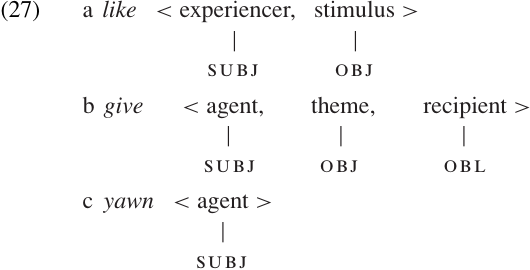
Our set of Phrase Structure (PS) rules allowed this kind of mismatch to occur because the rule which expands “S” (repeated in (28)) simply lists the post-verbal NP and PP as optional elements which can be freely included or omitted.
(28) S→NP V (NP) (PP)
Clearly we need some way to ensure that the number of NPs and PPs generated in the tree structure is appropriate for the specific verb which is chosen. One approach might be to break up the category of “verbs”(V) into three subsets: in transitive verbs (VINTR), transitive verbs (VTRANS), and ditransitive verbs (VDITRANS). We could then write separate rules expanding “S” in the correct way for each of these subcategories. 1

However, as we expand our inventory of verbs we quickly discover that three rules are not enough. Some verbs require not only an object NP but also a PP as oblique argument. Other verbs take a PP but no NP. As we will see, other verbs require or allow a following AP or S. If we tried to write additional rules to allow for every possible combination of these elements, the grammar would become hopelessly messy and redundant; we would also end up with a very large number of sub-classes for the category V.
A more efficient way of preventing sentences like those in(21) from being generated is to refer to the subcategorization information contained in the lexical entry of the verb. A fundamental assumption of most current approaches to syntactic analysis is that the structure of a clause is largely determined by the argument structure and subcategorization of its verb. We will express this principle through a set of constraints on possible clause structures, which we refer to as WELL-FORMEDNESS CONDITIONS.
1 Another way of adjusting the PS rules might be to make lexical insertion a context sensitive rule, but we will not explore this option here.
 الاكثر قراءة في Sentences
 اخر الاخبار
اخبار العتبة العباسية المقدسة









