

Grammar


Tenses


Present

Present Simple

Present Continuous

Present Perfect

Present Perfect Continuous


Past

Past Simple

Past Continuous

Past Perfect

Past Perfect Continuous


Future

Future Simple

Future Continuous

Future Perfect

Future Perfect Continuous


Parts Of Speech


Nouns

Countable and uncountable nouns

Verbal nouns

Singular and Plural nouns

Proper nouns

Nouns gender

Nouns definition

Concrete nouns

Abstract nouns

Common nouns

Collective nouns

Definition Of Nouns

Animate and Inanimate nouns

Nouns


Verbs

Stative and dynamic verbs

Finite and nonfinite verbs

To be verbs

Transitive and intransitive verbs

Auxiliary verbs

Modal verbs

Regular and irregular verbs

Action verbs

Verbs


Adverbs

Relative adverbs

Interrogative adverbs

Adverbs of time

Adverbs of place

Adverbs of reason

Adverbs of quantity

Adverbs of manner

Adverbs of frequency

Adverbs of affirmation

Adverbs


Adjectives

Quantitative adjective

Proper adjective

Possessive adjective

Numeral adjective

Interrogative adjective

Distributive adjective

Descriptive adjective

Demonstrative adjective


Pronouns

Subject pronoun

Relative pronoun

Reflexive pronoun

Reciprocal pronoun

Possessive pronoun

Personal pronoun

Interrogative pronoun

Indefinite pronoun

Emphatic pronoun

Distributive pronoun

Demonstrative pronoun

Pronouns


Pre Position


Preposition by function

Time preposition

Reason preposition

Possession preposition

Place preposition

Phrases preposition

Origin preposition

Measure preposition

Direction preposition

Contrast preposition

Agent preposition


Preposition by construction

Simple preposition

Phrase preposition

Double preposition

Compound preposition

prepositions


Conjunctions

Subordinating conjunction

Correlative conjunction

Coordinating conjunction

Conjunctive adverbs

conjunctions


Interjections

Express calling interjection

Phrases

Sentences


Grammar Rules

Passive and Active

Preference

Requests and offers

wishes

Be used to

Some and any

Could have done

Describing people

Giving advices

Possession

Comparative and superlative

Giving Reason

Making Suggestions

Apologizing

Forming questions

Since and for

Directions

Obligation

Adverbials

invitation

Articles

Imaginary condition

Zero conditional

First conditional

Second conditional

Third conditional

Reported speech

Demonstratives

Determiners


Linguistics

Phonetics

Phonology

Linguistics fields

Syntax

Morphology

Semantics

pragmatics

History

Writing

Grammar

Phonetics and Phonology

Semiotics


Reading Comprehension

Elementary

Intermediate

Advanced


Teaching Methods

Teaching Strategies

Assessment
Laying out the Elements
المؤلف:
BARBARA MINTO
المصدر:
THE MINTO PYRAMID PRINCIPLE
الجزء والصفحة:
122-8
2024-09-16
947
Laying out the Elements
Let me explain the elements of the framework using a deliberately simplistic example. Suppose you have a company that has for 30 years followed a tried-and-true method to sell a product that is in enormous demand, say industrial real estate. The salesmen simply make a list of their sales prospects, write a script of what they will say to the prospects, and then deliver the message.
The company has done phenomenally well over time, increasing its sales some 10% a year every year. This year, however, as it goes into the final quarter, indications are that sales instead of being up 10% will be down 10%. The news is naturally something of a shock, and the company wants to take action as quickly as possible to get sales back on track.
Think of the problem as emerging from an existing Situation (Exhibit 32). This Situation is made up of a Starting Point or Opening Scene that encompasses an existing structure or process (their standard selling approach). The process yields or is expected to yield a Desired Result (R2) of continued 10% annual growth. Something has happened or an action has been taken in the Situation (they calculated their projected sales) that led to the acknowledgement or revelation of a likely Undesired Result (R1), the threat that sales growth will be lower than expected.
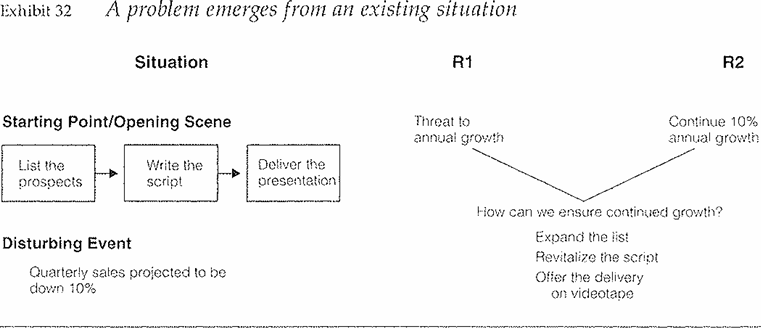
A gap now exists between what was delivered and what was expected. That gap is the problem. To solve the problem, one has to identify the causes of the gap and determine the steps required to close it. These causes will generally lie in the activities envisioned in the Opening Scene. Thus the Problem Definition Framework requires you to answer three questions:
- What's going on?
(Situation [Starting Point/Opening Scene+ Disturbing Event])
- What don't we like about it? (R1)
- What do we want instead? (R2)
Once these questions are answered, the problem is defined to the point where you can determine the Question generated by the problem and begin to look for the Solution. The Solution generally comes from changing what is going on in the structure or process identified as the original Starting Point/Opening Scene. In the case just described, if the sales are down, they are likely down because
-The list is no longer valid, and/or
-The script is not punchy enough, and/or
-The delivery is ineffective.
You are now in a position to structure the analysis of the problem. To that end, you will develop diagnostic frameworks and logic trees that enable you to do a complete breakdown of each area to identify the causes of sales being down. The steps in your solution will derive from these frameworks, and would likely cover fixing the list and/or the script and/or the delivery (Structuring the Analysis of the Problem, explains diagnostic frameworks for problem analysis and how to develop them.)
الاكثر قراءة في Writing
اخر الاخبار
اخبار العتبة العباسية المقدسة
الآخبار الصحية

قسم الشؤون الفكرية يصدر كتاباً يوثق تاريخ السدانة في العتبة العباسية المقدسة
"المهمة".. إصدار قصصي يوثّق القصص الفائزة في مسابقة فتوى الدفاع المقدسة للقصة القصيرة
(نوافذ).. إصدار أدبي يوثق القصص الفائزة في مسابقة الإمام العسكري (عليه السلام)


