Grammar
Tenses
Present

Present Simple
Present Continuous
Present Perfect
Present Perfect Continuous
Past
Past Simple
Past Continuous
Past Perfect
Past Perfect Continuous
Future
Future Simple
Future Continuous
Future Perfect
Future Perfect Continuous
Parts Of Speech
Nouns
Countable and uncountable nouns
Verbal nouns
Singular and Plural nouns
Proper nouns
Nouns gender
Nouns definition
Concrete nouns
Abstract nouns
Common nouns
Collective nouns
Definition Of Nouns
Animate and Inanimate nouns
Nouns
Verbs
Stative and dynamic verbs
Finite and nonfinite verbs
To be verbs
Transitive and intransitive verbs
Auxiliary verbs
Modal verbs
Regular and irregular verbs
Action verbs
Verbs
Adverbs
Relative adverbs
Interrogative adverbs
Adverbs of time
Adverbs of place
Adverbs of reason
Adverbs of quantity
Adverbs of manner
Adverbs of frequency
Adverbs of affirmation
Adverbs
Adjectives
Quantitative adjective
Proper adjective
Possessive adjective
Numeral adjective
Interrogative adjective
Distributive adjective
Descriptive adjective
Demonstrative adjective
Pronouns
Subject pronoun
Relative pronoun
Reflexive pronoun
Reciprocal pronoun
Possessive pronoun
Personal pronoun
Interrogative pronoun
Indefinite pronoun
Emphatic pronoun
Distributive pronoun
Demonstrative pronoun
Pronouns
Pre Position
Preposition by function
Time preposition
Reason preposition
Possession preposition
Place preposition
Phrases preposition
Origin preposition
Measure preposition
Direction preposition
Contrast preposition
Agent preposition
Preposition by construction
Simple preposition
Phrase preposition
Double preposition
Compound preposition
prepositions
Conjunctions
Subordinating conjunction
Correlative conjunction
Coordinating conjunction
Conjunctive adverbs
conjunctions
Interjections
Express calling interjection
Phrases
Sentences
Grammar Rules
Passive and Active
Preference
Requests and offers
wishes
Be used to
Some and any
Could have done
Describing people
Giving advices
Possession
Comparative and superlative
Giving Reason
Making Suggestions
Apologizing
Forming questions
Since and for
Directions
Obligation
Adverbials
invitation
Articles
Imaginary condition
Zero conditional
First conditional
Second conditional
Third conditional
Reported speech
Demonstratives
Determiners
Linguistics
Phonetics
Phonology
Linguistics fields
Syntax
Morphology
Semantics
pragmatics
History
Writing
Grammar
Phonetics and Phonology
Semiotics
Reading Comprehension
Elementary
Intermediate
Advanced
Teaching Methods
Teaching Strategies
Assessment

STATE THE EFFECT OF ACTIONS
 المؤلف:
BARBARA MINTO
المؤلف:
BARBARA MINTO
 المصدر:
THE MINTO PYRAMID PRINCIPLE
المصدر:
THE MINTO PYRAMID PRINCIPLE
 الجزء والصفحة:
98-7
الجزء والصفحة:
98-7
 2024-09-14
 1064
1064




+
-
20
STATE THE EFFECT OF ACTIONS
The great majority of ideas in business writing are statements of actions-i.e., statements described by such plural nouns as steps, recommendations, objectives, or changes. You use them when writing manuals, developing action plans, describing systems, or spelling out how to go about solving a problem. But stating, relating, and summarizing action ideas to tell people clearly how to do something or how something works is the hardest thinking I know. Witness the plethora of unreadable manuals in the world and the failure of Management by Objectives as an administrative technique.
The difficulty lies in the way actions relate. We know that, since actions are always taken to achieve some purpose, the summary of a set of actions is always the effect of carrying out the actions. Any MECE set of actions plus the effect they produce will together form a unique closed system, in the sense that if one takes that particular set of actions, one can be certain they will produce the effect stated. And a process that includes a large number of actions will consist of a hierarchy of unique closed systems (Exhibit 29).
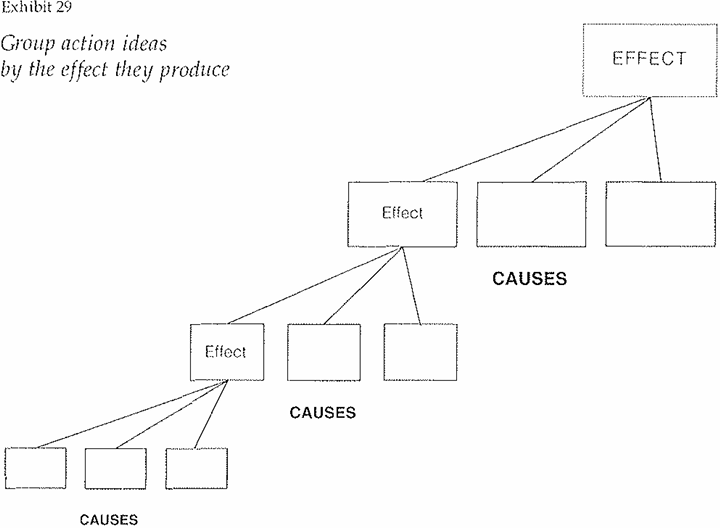
So far so good. The trouble is that the actions in any grouping are not significantly related to each other except in terms of the effect they together achieve. In other words, all actions look alike, whether they serve as cause or effect in the hierarchy. That is, they all imply the words "You should" or "We will", followed by a verb. This means you can't tell whether one action goes with another by looking at them. individually. You can only make the judgment in light of the effect you intend them to achieve.
Thus, if you make a list of the actions you think you should take to achieve some objective, you can't judge whether you have left any out until you state the effect they are meant to achieve. But the effect is in turn dependent on the specific actions you bring together. This interdependence can make sorting out your thinking a bit of a nightmare, particularly if you are trying to describe a lengthy process with many steps and substeps.
Fortunately; there are some techniques available to ease the job of sorting out your thinking and presenting it clearly:
- Word each action as specifically as possible before you try to relate then
- Look for obvious cause-effect groupings, so that you can keep the steps in each grouping to five or fewer
- Derive the effect directly from the statements of the actions
 الاكثر قراءة في Writing
 اخر الاخبار
اخبار العتبة العباسية المقدسة

الآخبار الصحية


مواضيع ذات صلة
 قسم الشؤون الفكرية يصدر كتاباً يوثق تاريخ السدانة في العتبة العباسية المقدسة
 "المهمة".. إصدار قصصي يوثّق القصص الفائزة في مسابقة فتوى الدفاع المقدسة للقصة القصيرة
 (نوافذ).. إصدار أدبي يوثق القصص الفائزة في مسابقة الإمام العسكري (عليه السلام)