Grammar
Tenses
Present

Present Simple
Present Continuous
Present Perfect
Present Perfect Continuous
Past
Past Simple
Past Continuous
Past Perfect
Past Perfect Continuous
Future
Future Simple
Future Continuous
Future Perfect
Future Perfect Continuous
Parts Of Speech
Nouns
Countable and uncountable nouns
Verbal nouns
Singular and Plural nouns
Proper nouns
Nouns gender
Nouns definition
Concrete nouns
Abstract nouns
Common nouns
Collective nouns
Definition Of Nouns
Animate and Inanimate nouns
Nouns
Verbs
Stative and dynamic verbs
Finite and nonfinite verbs
To be verbs
Transitive and intransitive verbs
Auxiliary verbs
Modal verbs
Regular and irregular verbs
Action verbs
Verbs
Adverbs
Relative adverbs
Interrogative adverbs
Adverbs of time
Adverbs of place
Adverbs of reason
Adverbs of quantity
Adverbs of manner
Adverbs of frequency
Adverbs of affirmation
Adverbs
Adjectives
Quantitative adjective
Proper adjective
Possessive adjective
Numeral adjective
Interrogative adjective
Distributive adjective
Descriptive adjective
Demonstrative adjective
Pronouns
Subject pronoun
Relative pronoun
Reflexive pronoun
Reciprocal pronoun
Possessive pronoun
Personal pronoun
Interrogative pronoun
Indefinite pronoun
Emphatic pronoun
Distributive pronoun
Demonstrative pronoun
Pronouns
Pre Position
Preposition by function
Time preposition
Reason preposition
Possession preposition
Place preposition
Phrases preposition
Origin preposition
Measure preposition
Direction preposition
Contrast preposition
Agent preposition
Preposition by construction
Simple preposition
Phrase preposition
Double preposition
Compound preposition
prepositions
Conjunctions
Subordinating conjunction
Correlative conjunction
Coordinating conjunction
Conjunctive adverbs
conjunctions
Interjections
Express calling interjection
Phrases
Sentences
Grammar Rules
Passive and Active
Preference
Requests and offers
wishes
Be used to
Some and any
Could have done
Describing people
Giving advices
Possession
Comparative and superlative
Giving Reason
Making Suggestions
Apologizing
Forming questions
Since and for
Directions
Obligation
Adverbials
invitation
Articles
Imaginary condition
Zero conditional
First conditional
Second conditional
Third conditional
Reported speech
Demonstratives
Determiners
Linguistics
Phonetics
Phonology
Linguistics fields
Syntax
Morphology
Semantics
pragmatics
History
Writing
Grammar
Phonetics and Phonology
Semiotics
Reading Comprehension
Elementary
Intermediate
Advanced
Teaching Methods
Teaching Strategies
Assessment

Creating Proper Class Groupings
 المؤلف:
BARBARA MINTO
المؤلف:
BARBARA MINTO
 المصدر:
THE MINTO PYRAMID PRINCIPLE
المصدر:
THE MINTO PYRAMID PRINCIPLE
 الجزء والصفحة:
89-6
الجزء والصفحة:
89-6
 2024-09-14
 1047
1047




+
-
20
Creating Proper Class Groupings
In classifying, when you say, "The company has three problems," your mind automatically separates these three problems from all other possible problems the company has or could have, creating a bifurcate structure like that shown in Exhibit 25. The two classes formed are by definition collectively exhaustive, and are of course meant to be mutually exclusive.
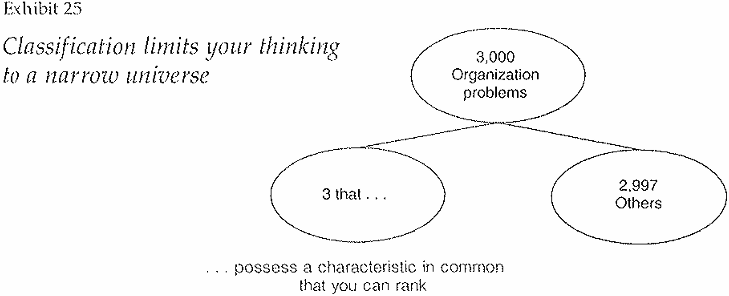
You prove they are mutually exclusive by defining quite specifically what characteristic they have in common, and then searching your knowledge to make sure you have included in your grouping all known items with this same characteristic. Then you place them in the order of the degree to which each possesses the characteristic by which you classified it-presenting the strongest one first.
Many people ask me whether, having determined the relative weight of the points, you always have to put the strongest one first. They point out that it would be more dramatic to put the weakest one first and work up to the strongest one. It would indeed be more dramatic, but being dramatic is an emotional consideration, not a logical one, and thus becomes a matter of style. In same cases you may quite legitimately decide to reverse the order for greater emotional impact.
In most cases, however, you put the strongest point first. Thus, suppose you write the following:
Telecom's billing system should be designed to be broadly useful
I. Meet outside customer needs
2. Satisfy internal management requirements
3. Conform to outside regulations
Although the system must meet all three functional needs, the order here implies that the cust0mer is more important to satisfy than the outside regulator. And underneath that assessment was this automatic classification:
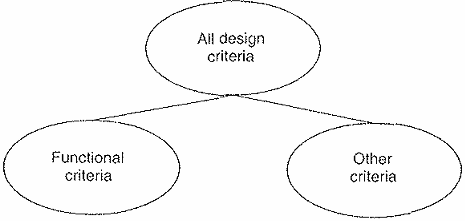
It turns out that order based on class groupings is much less widely used in business writing than is either time order or structural order. This is not to say that classifying does not go on. Classifying is a ubiquitous human habit, and people classify everything they see as soon as they see it, simply by naming what it is. But they do not limit themselves to creating classes of points that are alike only by virtue of their possessing a characteristic in common. They also consider ideas to be alike, and therefore classifiable, if they were derived front the same process or drawn front the same structure.
This is a perfectly legitimate thing to do, provided that you are clear about the source of your grouping and reflect accordingly the order it imposes. Here, for example, is a point supported by three "reasons"…
You should not consider a Vendor Capture strategy (Vendor Capture is trading your warehouse space in return for vendor exclusivity)
1. Your warehouses are neither large enough nor ideally located
2. Even if they were, the approach requires double handling
3. Even if you accept that, the possible admin-mileage savings are negligible
…but the order implies an existing structure (you have the warehouse, within which you have the process, from which you calculate the savings).
 الاكثر قراءة في Writing
 اخر الاخبار
اخبار العتبة العباسية المقدسة

الآخبار الصحية


مواضيع ذات صلة
 قسم الشؤون الفكرية يصدر كتاباً يوثق تاريخ السدانة في العتبة العباسية المقدسة
 "المهمة".. إصدار قصصي يوثّق القصص الفائزة في مسابقة فتوى الدفاع المقدسة للقصة القصيرة
 (نوافذ).. إصدار أدبي يوثق القصص الفائزة في مسابقة الإمام العسكري (عليه السلام)