Grammar
Tenses
Present

Present Simple
Present Continuous
Present Perfect
Present Perfect Continuous
Past
Past Simple
Past Continuous
Past Perfect
Past Perfect Continuous
Future
Future Simple
Future Continuous
Future Perfect
Future Perfect Continuous
Parts Of Speech
Nouns
Countable and uncountable nouns
Verbal nouns
Singular and Plural nouns
Proper nouns
Nouns gender
Nouns definition
Concrete nouns
Abstract nouns
Common nouns
Collective nouns
Definition Of Nouns
Animate and Inanimate nouns
Nouns
Verbs
Stative and dynamic verbs
Finite and nonfinite verbs
To be verbs
Transitive and intransitive verbs
Auxiliary verbs
Modal verbs
Regular and irregular verbs
Action verbs
Verbs
Adverbs
Relative adverbs
Interrogative adverbs
Adverbs of time
Adverbs of place
Adverbs of reason
Adverbs of quantity
Adverbs of manner
Adverbs of frequency
Adverbs of affirmation
Adverbs
Adjectives
Quantitative adjective
Proper adjective
Possessive adjective
Numeral adjective
Interrogative adjective
Distributive adjective
Descriptive adjective
Demonstrative adjective
Pronouns
Subject pronoun
Relative pronoun
Reflexive pronoun
Reciprocal pronoun
Possessive pronoun
Personal pronoun
Interrogative pronoun
Indefinite pronoun
Emphatic pronoun
Distributive pronoun
Demonstrative pronoun
Pronouns
Pre Position
Preposition by function
Time preposition
Reason preposition
Possession preposition
Place preposition
Phrases preposition
Origin preposition
Measure preposition
Direction preposition
Contrast preposition
Agent preposition
Preposition by construction
Simple preposition
Phrase preposition
Double preposition
Compound preposition
prepositions
Conjunctions
Subordinating conjunction
Correlative conjunction
Coordinating conjunction
Conjunctive adverbs
conjunctions
Interjections
Express calling interjection
Phrases
Sentences
Grammar Rules
Passive and Active
Preference
Requests and offers
wishes
Be used to
Some and any
Could have done
Describing people
Giving advices
Possession
Comparative and superlative
Giving Reason
Making Suggestions
Apologizing
Forming questions
Since and for
Directions
Obligation
Adverbials
invitation
Articles
Imaginary condition
Zero conditional
First conditional
Second conditional
Third conditional
Reported speech
Demonstratives
Determiners
Linguistics
Phonetics
Phonology
Linguistics fields
Syntax
Morphology
Semantics
pragmatics
History
Writing
Grammar
Phonetics and Phonology
Semiotics
Reading Comprehension
Elementary
Intermediate
Advanced
Teaching Methods
Teaching Strategies
Assessment

East and Southeast Asia
 المؤلف:
P. John McWhorter
المؤلف:
P. John McWhorter
 المصدر:
The Story of Human Language
المصدر:
The Story of Human Language
 الجزء والصفحة:
48-10
الجزء والصفحة:
48-10
 2024-01-11
 900
900




+
-
20
East and Southeast Asia
A. This area actually contains several families. The main three are Sino-Tibetan, which includes Chinese, Tibetan, and Burmese; Tai-Kadai, which includes Thai and Laotian; and Austroasiatic, which includes Vietnamese and Khmer.
B. Heavy reliance on context. These languages stand out in being especially telegraphic compared to most languages. It is natural to suppose that a “normal” language has separate words for he and she, or words for a and the, or must always express pronominal concepts, such as “I” and “you,” either with a word or with the endings that we learn in Spanish. But Cantonese goes against all of these notions, as do most languages in this area. Notice also how differently Cantonese puts a thought together than English does.
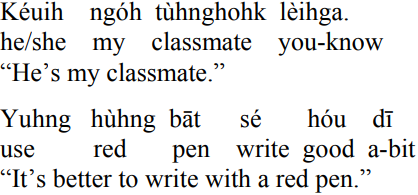
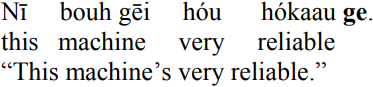
C. Particles. Thus, an English speaker thinks of a and the and he and she as crucial things to mark in a language. But there are things that an English speaker would not conceive of as “grammar” that speakers of these languages do. For example, where we would say “This machine’s very reliable” in a tone of voice objecting to someone denying this, in Cantonese the assertive attitude that this tone of voice conveys is also marked with a particle at the end of the sentence:
In the same way, if someone asked us why we weren’t sleeping and we answered “It’s too noisy,” we leave it to context that we are saying this in response to a situation going on at that time. But in Cantonese, this is actually “said,” with a particle that conveys immediate relevance:
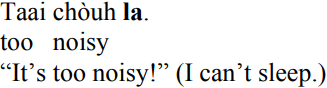
You can even combine particles like this. In this sentence, the person is both asserting and speaking of something immediately relevant; therefore, ge and la are used together.

“All I want is for Vincent to be good to me.”
Cantonese has about 30 particles like this, marking attitudes that English often leaves to context or conveys with intonation. There were particles in the first Cantonese examples we saw earlier.
D. Classifiers. Instead of marking nouns with articles as in English, languages in this area use classifiers with nouns according to their shape, especially with numbers. This practice is similar to using such English expressions as two head of cattle, but these languages use this kind of construction regularly.
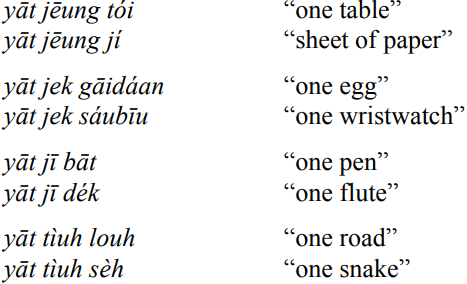
Cantonese uses jēung with flat objects, such as tables and paper; jek with round objects; jī with cylindrical objects; tìuh with long, thin objects; and so on. There are dozens of these words.
 الاكثر قراءة في Linguistics fields
 اخر الاخبار
اخبار العتبة العباسية المقدسة

الآخبار الصحية


مواضيع ذات صلة
 قسم الشؤون الفكرية يصدر كتاباً يوثق تاريخ السدانة في العتبة العباسية المقدسة
 "المهمة".. إصدار قصصي يوثّق القصص الفائزة في مسابقة فتوى الدفاع المقدسة للقصة القصيرة
 (نوافذ).. إصدار أدبي يوثق القصص الفائزة في مسابقة الإمام العسكري (عليه السلام)