Grammar
Tenses
Present

Present Simple
Present Continuous
Present Perfect
Present Perfect Continuous
Past
Past Simple
Past Continuous
Past Perfect
Past Perfect Continuous
Future
Future Simple
Future Continuous
Future Perfect
Future Perfect Continuous
Parts Of Speech
Nouns
Countable and uncountable nouns
Verbal nouns
Singular and Plural nouns
Proper nouns
Nouns gender
Nouns definition
Concrete nouns
Abstract nouns
Common nouns
Collective nouns
Definition Of Nouns
Animate and Inanimate nouns
Nouns
Verbs
Stative and dynamic verbs
Finite and nonfinite verbs
To be verbs
Transitive and intransitive verbs
Auxiliary verbs
Modal verbs
Regular and irregular verbs
Action verbs
Verbs
Adverbs
Relative adverbs
Interrogative adverbs
Adverbs of time
Adverbs of place
Adverbs of reason
Adverbs of quantity
Adverbs of manner
Adverbs of frequency
Adverbs of affirmation
Adverbs
Adjectives
Quantitative adjective
Proper adjective
Possessive adjective
Numeral adjective
Interrogative adjective
Distributive adjective
Descriptive adjective
Demonstrative adjective
Pronouns
Subject pronoun
Relative pronoun
Reflexive pronoun
Reciprocal pronoun
Possessive pronoun
Personal pronoun
Interrogative pronoun
Indefinite pronoun
Emphatic pronoun
Distributive pronoun
Demonstrative pronoun
Pronouns
Pre Position
Preposition by function
Time preposition
Reason preposition
Possession preposition
Place preposition
Phrases preposition
Origin preposition
Measure preposition
Direction preposition
Contrast preposition
Agent preposition
Preposition by construction
Simple preposition
Phrase preposition
Double preposition
Compound preposition
prepositions
Conjunctions
Subordinating conjunction
Correlative conjunction
Coordinating conjunction
Conjunctive adverbs
conjunctions
Interjections
Express calling interjection
Phrases
Sentences
Grammar Rules
Passive and Active
Preference
Requests and offers
wishes
Be used to
Some and any
Could have done
Describing people
Giving advices
Possession
Comparative and superlative
Giving Reason
Making Suggestions
Apologizing
Forming questions
Since and for
Directions
Obligation
Adverbials
invitation
Articles
Imaginary condition
Zero conditional
First conditional
Second conditional
Third conditional
Reported speech
Demonstratives
Determiners
Linguistics
Phonetics
Phonology
Linguistics fields
Syntax
Morphology
Semantics
pragmatics
History
Writing
Grammar
Phonetics and Phonology
Semiotics
Reading Comprehension
Elementary
Intermediate
Advanced
Teaching Methods
Teaching Strategies
Assessment

how vastly languages diverge from one another over time
 المؤلف:
P. John McWhorter
المؤلف:
P. John McWhorter
 المصدر:
The Story of Human Language
المصدر:
The Story of Human Language
 الجزء والصفحة:
38-8
الجزء والصفحة:
38-8
 2024-01-10
 1080
1080




+
-
20
Although the Indo-European languages have a great deal in common, they also demonstrate how vastly languages diverge from one another over time.
A. Germanic.
1. This group includes German, Dutch, Swedish and its close relatives Norwegian and Danish, Icelandic, Yiddish, and a few lesser-known languages, such as Frisian and Faroese, as well as Afrikaans spoken in South Africa.
2. A strange sound change took place in the ancestor of this group, explained by Grimm’s law, which was named after its discoverer, the same Jacob Grimm who collected folk tales.
Grimm’s Law: Latin and Greek to English
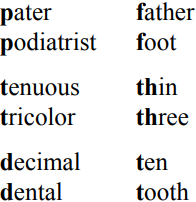
For some reason, in many places where Proto-Indo-European had a p, Proto-Germanic switched this to an f. This is why Latin has pater and Sanskrit has pitár, but English has father and German has Vater (pronounced “FAH-ter”). There were many switches like this; t changed to a th sound in Germanic, so that while a word we borrowed from Latin, such as tenuous, has a t, the native Germanic rendition of the word has a th. In the same way, Proto-Indo-European’s d changed into a t in Germanic. This is why we have ten where Latin had decem, the root in some words we borrowed, including decimal, and why we have tooth where Latin had dēns, Sanskrit had dán, and Ancient Greek had odón.
B. Celtic.
1. These languages are now few, all under severe threat: Irish Gaelic, Scotch Gaelic, Welsh, and Breton spoken in France. Celtic was once spoken across Europe and even in what is now Turkey, but the languages have been edged to the western fringe of Europe by waves of invaders.
2. Celtic languages are well known for their mutations, where proper expression requires switching consonants at the beginning of words for no apparent reason, and sometimes the switch alone conveys important meanings.
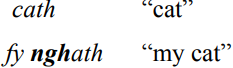
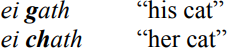
In Welsh, the word for cat is cath, but to say my cat requires also changing the initial c to ngh. And then, this kind of change is the only way to distinguish between his cat and her cat.
C. Baltic versus Italic: Old-fashioned versus up-to-the-minute.
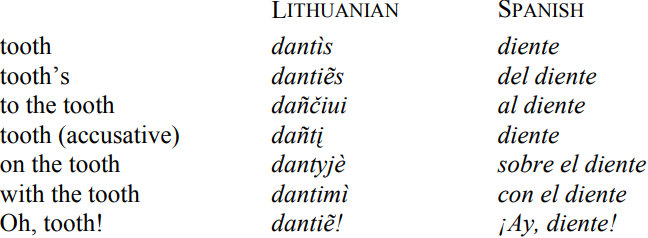
1. Some languages are more conservative than others–that is, they change more slowly. Some Indo-European families have retained a striking amount of Proto-Indo-European structure over the millennia. Others have shed a surprising amount. Lithuanian is of the Baltic family (which today has only one other member, Latvian), and it preserves seven cases, a record among living Indo-European members.
2. As it happens, one of the Indo-European groups most familiar to us is one of the least “faithful” to its ancestor in terms of case endings. Italic once included Latin and other dead languages, but today lives only through the children of Latin alone; Spanish is one. Spanish has not a single one of the Proto-Indo-European case endings. (There is a likely reason for this kind of difference, which we will explore later.)
D. Albanian and Armenian: Black sheep.
1. Other groups have been so innovative that they are difficult to even recognize as family members. Albanian is the language that would have been spoken by the Twelfth Night characters because the play takes place east of the Adriatic in the Illyrian region. Armenian is spoken between the Black Sea and the Caspian Sea. Both of these languages are the only members of their family.
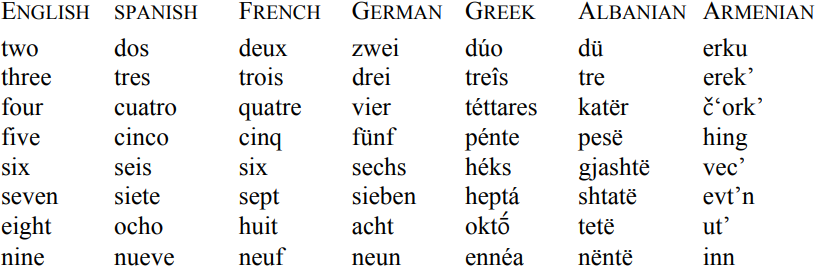
2. Both have borrowed many words from other language groups: only about 1 in 12 Albanian words is native to the language and only about 1 in 4 Armenian ones. Both languages have also wended quite far along their own paths of development. Albanian wasn’t even discovered to be Indo-European until 1854, and Armenian was long thought to be a kind of Persian. Here are the numbers 2 through 9 in Albanian and Armenian, compared to “normal” Indo-European languages. The Albanian and Armenian words come from the same ancestor as the other languages’ words do, but look how differently they often come out:
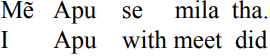
E. Indo-European: The “Indo” part. In India, Indo-European languages have taken on many features from the grammars of languages spoken by peoples who first occupied the area, such as the Dravidian languages that are still spoken in southern India today, including Tamil. An example is word order. In Hindi, the verb comes at the end of the sentence, and prepositions come after nouns. Thus, in Hindi, I met Apu is “I Apu-with met-did.”
“I met Apu.”
 الاكثر قراءة في Linguistics fields
 اخر الاخبار
اخبار العتبة العباسية المقدسة

الآخبار الصحية


مواضيع ذات صلة
 قسم الشؤون الفكرية يصدر كتاباً يوثق تاريخ السدانة في العتبة العباسية المقدسة
 "المهمة".. إصدار قصصي يوثّق القصص الفائزة في مسابقة فتوى الدفاع المقدسة للقصة القصيرة
 (نوافذ).. إصدار أدبي يوثق القصص الفائزة في مسابقة الإمام العسكري (عليه السلام)