Grammar
Tenses
Present

Present Simple
Present Continuous
Present Perfect
Present Perfect Continuous
Past
Past Simple
Past Continuous
Past Perfect
Past Perfect Continuous
Future
Future Simple
Future Continuous
Future Perfect
Future Perfect Continuous
Parts Of Speech
Nouns
Countable and uncountable nouns
Verbal nouns
Singular and Plural nouns
Proper nouns
Nouns gender
Nouns definition
Concrete nouns
Abstract nouns
Common nouns
Collective nouns
Definition Of Nouns
Animate and Inanimate nouns
Nouns
Verbs
Stative and dynamic verbs
Finite and nonfinite verbs
To be verbs
Transitive and intransitive verbs
Auxiliary verbs
Modal verbs
Regular and irregular verbs
Action verbs
Verbs
Adverbs
Relative adverbs
Interrogative adverbs
Adverbs of time
Adverbs of place
Adverbs of reason
Adverbs of quantity
Adverbs of manner
Adverbs of frequency
Adverbs of affirmation
Adverbs
Adjectives
Quantitative adjective
Proper adjective
Possessive adjective
Numeral adjective
Interrogative adjective
Distributive adjective
Descriptive adjective
Demonstrative adjective
Pronouns
Subject pronoun
Relative pronoun
Reflexive pronoun
Reciprocal pronoun
Possessive pronoun
Personal pronoun
Interrogative pronoun
Indefinite pronoun
Emphatic pronoun
Distributive pronoun
Demonstrative pronoun
Pronouns
Pre Position
Preposition by function
Time preposition
Reason preposition
Possession preposition
Place preposition
Phrases preposition
Origin preposition
Measure preposition
Direction preposition
Contrast preposition
Agent preposition
Preposition by construction
Simple preposition
Phrase preposition
Double preposition
Compound preposition
prepositions
Conjunctions
Subordinating conjunction
Correlative conjunction
Coordinating conjunction
Conjunctive adverbs
conjunctions
Interjections
Express calling interjection
Phrases
Sentences
Grammar Rules
Passive and Active
Preference
Requests and offers
wishes
Be used to
Some and any
Could have done
Describing people
Giving advices
Possession
Comparative and superlative
Giving Reason
Making Suggestions
Apologizing
Forming questions
Since and for
Directions
Obligation
Adverbials
invitation
Articles
Imaginary condition
Zero conditional
First conditional
Second conditional
Third conditional
Reported speech
Demonstratives
Determiners
Linguistics
Phonetics
Phonology
Linguistics fields
Syntax
Morphology
Semantics
pragmatics
History
Writing
Grammar
Phonetics and Phonology
Semiotics
Reading Comprehension
Elementary
Intermediate
Advanced
Teaching Methods
Teaching Strategies
Assessment

Other properties Comparatives
 المؤلف:
R.M.W. Dixon
المؤلف:
R.M.W. Dixon
 المصدر:
A Semantic approach to English grammar
المصدر:
A Semantic approach to English grammar
 الجزء والصفحة:
423-12
الجزء والصفحة:
423-12
 2023-04-25
 1505
1505




+
-
20
Other properties
Comparatives
Forming comparatives is a property of adjectives which they may pass on to adverbs derived from them. Basically, adverbs have a comparative form if:
- They are derived from an adjective by the addition of -ly, with no significant change of meaning being involved.
- They are used in manner function, generally in position O.
Comparatives are thus formed from adjectives. (those that occur in manner but not in sentential function), (those that occur in both manner and sentential function). Similarly is an exception; because of its meaning, this is unlikely to be used in a comparative. Note that there are no comparatives of monomorphemic adverbs (such as rather, quite) nor of forms ending in -ly where there is a significant meaning difference from the corresponding adjective (such as really, slightly).
There are just a few adverbs (ending in -ly) that generally occur only in sentential function, which may form comparatives. The comparative is then used in manner function, generally in position O. This applies to usually, normally, obviously and deliberately, from sets and to permanently: for example, They flirted more obviously on the second occasion. It also applies to the monomorphemic time adverb often: for example, He now arrives late more often (than he did before); and also the idiomatic adverb more often than not. And it applies to soon and later.
We saw how some adjectives form the comparative by adding -er, some by preposing more, and some by either means. However, English does not permit a sequence of -er plus -ly, and as a consequence the regular comparative of adverbs always uses more. Alongside ruder we get more rudely, alongside more careful there is more carefully, and corresponding to both cleverer and more clever there is just more cleverly.
There are just a few exceptions:
. Fast, hard, early and late have the same form for adjective and adverb, and the comparatives faster, harder, earlier and later also function as adjective and as adverb; for example, A faster car goes faster (than a slower one).
. The adjectives quick, slow and long form regular comparatives, quicker, slower and longer. However, there are alternative forms for the corresponding adverbs—quick or quickly, slow or slowly, and long or lengthily. Each of these adverbs has its own comparative— one can say quicker or more quickly, slower or more slowly, and longer or more lengthily.
. And for good and bad we have suppletive forms:
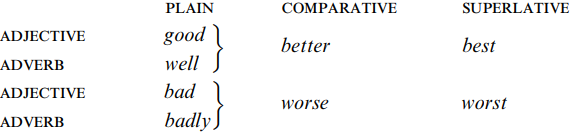
One interesting property of comparatives is the behavior of forms like very (much), terribly (much) and awfully (much). We can recall that their forms and functions are as follows (illustrating here for very (much)):
The form very much is used
—when modifying an NP, as in She is very much a professor
—when in manner function, as in She very much likes it or She likes it very much
Form very is used
—when modifying an adjective, as in I saw a very strange sight
—when modifying an adverb, such as He behaved very strangely
Now when very (much) modifies a comparative adjective or a comparative adverb, both forms—very and very much—can be used, as in:
(63a) Mary is much more beautiful (than Jane)
(63b) Mary is very much more beautiful (than Jane)
(64a) Jane did it much more cleverly (than Mary)
(64b) Jane did it very much more cleverly (than Mary)
Very much (or terribly much, awfully much, etc.) implies a higher degree of the quality than plain much.
With a verb such as like, one can use very much but not much as manner modifier (*She much likes it and *She likes it much are not acceptable). However, with prefer both much and very much are possible, as in:
(65a) I much prefer Bach (to Beethoven)
(65b) I very much prefer Bach (to Beethoven)
This shows that the verb prefer has an inherently comparative meaning.
An adjective which forms a comparative with -er or more forms a superlative by suffixing -est or preposing most. Basically, this carries over into adverbs (employing most), although the superlative of an adverb is not very common. It may be most frequent with adverbs: for example, Most sensibly, she dressed up warmly in the winter cold and It is most appropriately regarded as a nonce form. One can also say She did it best/very cleverely/most cleverly.
 الاكثر قراءة في Semantics
 اخر الاخبار
اخبار العتبة العباسية المقدسة

الآخبار الصحية


مواضيع ذات صلة
 قسم الشؤون الفكرية يصدر كتاباً يوثق تاريخ السدانة في العتبة العباسية المقدسة
 "المهمة".. إصدار قصصي يوثّق القصص الفائزة في مسابقة فتوى الدفاع المقدسة للقصة القصيرة
 (نوافذ).. إصدار أدبي يوثق القصص الفائزة في مسابقة الإمام العسكري (عليه السلام)