Grammar
Tenses
Present

Present Simple
Present Continuous
Present Perfect
Present Perfect Continuous
Past
Past Simple
Past Continuous
Past Perfect
Past Perfect Continuous
Future
Future Simple
Future Continuous
Future Perfect
Future Perfect Continuous
Parts Of Speech
Nouns
Countable and uncountable nouns
Verbal nouns
Singular and Plural nouns
Proper nouns
Nouns gender
Nouns definition
Concrete nouns
Abstract nouns
Common nouns
Collective nouns
Definition Of Nouns
Animate and Inanimate nouns
Nouns
Verbs
Stative and dynamic verbs
Finite and nonfinite verbs
To be verbs
Transitive and intransitive verbs
Auxiliary verbs
Modal verbs
Regular and irregular verbs
Action verbs
Verbs
Adverbs
Relative adverbs
Interrogative adverbs
Adverbs of time
Adverbs of place
Adverbs of reason
Adverbs of quantity
Adverbs of manner
Adverbs of frequency
Adverbs of affirmation
Adverbs
Adjectives
Quantitative adjective
Proper adjective
Possessive adjective
Numeral adjective
Interrogative adjective
Distributive adjective
Descriptive adjective
Demonstrative adjective
Pronouns
Subject pronoun
Relative pronoun
Reflexive pronoun
Reciprocal pronoun
Possessive pronoun
Personal pronoun
Interrogative pronoun
Indefinite pronoun
Emphatic pronoun
Distributive pronoun
Demonstrative pronoun
Pronouns
Pre Position
Preposition by function
Time preposition
Reason preposition
Possession preposition
Place preposition
Phrases preposition
Origin preposition
Measure preposition
Direction preposition
Contrast preposition
Agent preposition
Preposition by construction
Simple preposition
Phrase preposition
Double preposition
Compound preposition
prepositions
Conjunctions
Subordinating conjunction
Correlative conjunction
Coordinating conjunction
Conjunctive adverbs
conjunctions
Interjections
Express calling interjection
Phrases
Sentences
Grammar Rules
Passive and Active
Preference
Requests and offers
wishes
Be used to
Some and any
Could have done
Describing people
Giving advices
Possession
Comparative and superlative
Giving Reason
Making Suggestions
Apologizing
Forming questions
Since and for
Directions
Obligation
Adverbials
invitation
Articles
Imaginary condition
Zero conditional
First conditional
Second conditional
Third conditional
Reported speech
Demonstratives
Determiners
Linguistics
Phonetics
Phonology
Linguistics fields
Syntax
Morphology
Semantics
pragmatics
History
Writing
Grammar
Phonetics and Phonology
Semiotics
Reading Comprehension
Elementary
Intermediate
Advanced
Teaching Methods
Teaching Strategies
Assessment

Adverbs with both sentential and manner function
 المؤلف:
R.M.W. Dixon
المؤلف:
R.M.W. Dixon
 المصدر:
A Semantic approach to English grammar
المصدر:
A Semantic approach to English grammar
 الجزء والصفحة:
418-12
الجزء والصفحة:
418-12
 2023-04-22
 1971
1971




+
-
20
Adverbs with both sentential and manner function
We summarized the properties of adverbs with both sentential and manner function, divided into five sets.
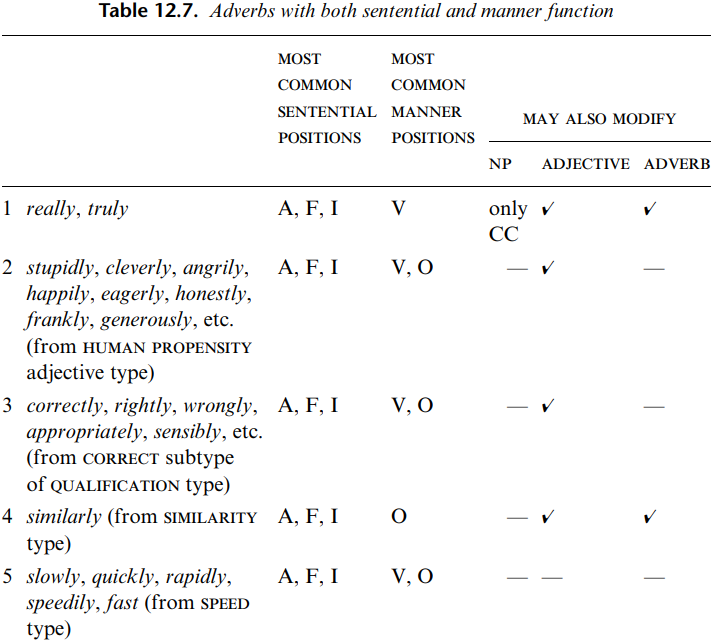
Set (1) involves really and truly, which were in row (h). These are the most omni-functional of adverbs. As illustrated for really, they have all five functions. In addition, they may modify an adverb-plus-adjective, or an adverb-plus-adverb. For example:

We frequently find these two adverbs coordinated, as one complex adverb; they are always in the order really and truly. For example, He really and truly believed me, and She is really and truly the most beautiful person I have ever seen.
Really and truly often modify an adverb from set (2), which may be repeated. Really or truly may then also be repeated. That is, one can say any of:

However, really (or truly) is not likely to be repeated unless the following adverb is; that is one would not expect to hear *really really very good. For very could be substituted terribly, awfully, etc.
All of the remaining sets involve adverbs derived from adjectives by the addition of -ly. The way in which stupidly occurs in sentential function at positions A, I and F and in manner function at positions V and O was already illustrated. Using stupidly in sentential function, as in (13a–c), implies that the soldier was stupid to answer the officer’s question, whereas using the adverb in manner function, as in (14a– b), implies that he answered the question in a stupid manner.
Set (2) covers adverbs derived from HUMAN PROPENSITY adjectives. Alongside stupidly we have cleverly, angrily, happily, eagerly and many others. In some contexts it is not easy to identify the different meanings these adverbs have in their sentential and manner functions. However, there always is an implied meaning difference, which can be brought out in an appropriate context. Consider happily, for instance. It is used in sentential function in (59a–c):

These sentences imply that the speaker is happy about John’s studying for the examination, without any implication that John is happy about doing this (he might be or he might not be). Now consider happily used as a manner adverb, in (60a–b).

These sentences state that John is studying in a happy mode.
Most adverbs retain the same meaning but just provide different kinds of modification when used in sentential and in manner functions. For example, sensibly means ‘it is sensible to do it’ in sentential and ‘it is done in a sensible way’ in manner function. But for some adverbs there is a slight meaning difference between the two functions. This was illustrated for quietly at (18a–b) and for honestly at (19a–b); it was there noted that frankly shows a similar difference.
Set (3) consists of adverbs from the CORRECT subset of the QUALIFICATION type of adjectives—correctly, rightly, wrongly, appropriately, and sensibly (mentioned in the preceding paragraph). These behave in a similar way to adverbs in set (2). For example, correctly could be substituted for stupidly in (13a–c)—stating that the soldier was correct to offer an answer to the question—and in (14a–b)—stating that he provided the correct answer. Adverbs from sets (2) and (3) may also modify an adjective (for example, stupidly anxious, appropriately diligent).
Set (4) consists just of similarly. This generally relates to something preceding in discourse. Suppose one person says Mary has been making a model. Someone else could reply, using any of:

Sentences (61a–c) state that John has been doing a similar thing to Mary, making a model. In contrast, (62) says that he has been making a model in a similar manner to Mary. It appears that, in manner function, similarly is restricted to position O. Similarly may also modify an adjective or an adverb; for example, similarly clever(ly).
The other items in the SIMILARITY semantic type do not pattern in this way. Differently simply functions as manner adverb in position O. Separately and independently function as manner adverbs in positions V and O. Adjectives like and unlike do not form adverbs since in modern English there already exist forms likely and unlikely with quite different meanings.
Set (5) involves adverbs derived from adjectives of the SPEED semantic type—slowly, quickly, rapidly, speedily and also fast (where adjective and adverb have the same form). These may occur in the three sentential and two manner positions. Of all the adverbs, these pose the most difficulty for perceiving distinct sentential and manner function senses. It seems that the manner positions are used to describe the speed of a volitional action; for example, She has been [(slowly) writing her memoirs (slowly)]. And the sentential positions may be preferred to describe the speed at which something happens; for example, (Slowly) she has (slowly) been gaining in confidence (slowly). These adverbs are unlikely to occur with LIKING verbs; and they do not easily modify adjectives or adverbs.
 الاكثر قراءة في Semantics
 اخر الاخبار
اخبار العتبة العباسية المقدسة

الآخبار الصحية


مواضيع ذات صلة
 قسم الشؤون الفكرية يصدر كتاباً يوثق تاريخ السدانة في العتبة العباسية المقدسة
 "المهمة".. إصدار قصصي يوثّق القصص الفائزة في مسابقة فتوى الدفاع المقدسة للقصة القصيرة
 (نوافذ).. إصدار أدبي يوثق القصص الفائزة في مسابقة الإمام العسكري (عليه السلام)