Grammar
Tenses
Present

Present Simple
Present Continuous
Present Perfect
Present Perfect Continuous
Past
Past Simple
Past Continuous
Past Perfect
Past Perfect Continuous
Future
Future Simple
Future Continuous
Future Perfect
Future Perfect Continuous
Parts Of Speech
Nouns
Countable and uncountable nouns
Verbal nouns
Singular and Plural nouns
Proper nouns
Nouns gender
Nouns definition
Concrete nouns
Abstract nouns
Common nouns
Collective nouns
Definition Of Nouns
Animate and Inanimate nouns
Nouns
Verbs
Stative and dynamic verbs
Finite and nonfinite verbs
To be verbs
Transitive and intransitive verbs
Auxiliary verbs
Modal verbs
Regular and irregular verbs
Action verbs
Verbs
Adverbs
Relative adverbs
Interrogative adverbs
Adverbs of time
Adverbs of place
Adverbs of reason
Adverbs of quantity
Adverbs of manner
Adverbs of frequency
Adverbs of affirmation
Adverbs
Adjectives
Quantitative adjective
Proper adjective
Possessive adjective
Numeral adjective
Interrogative adjective
Distributive adjective
Descriptive adjective
Demonstrative adjective
Pronouns
Subject pronoun
Relative pronoun
Reflexive pronoun
Reciprocal pronoun
Possessive pronoun
Personal pronoun
Interrogative pronoun
Indefinite pronoun
Emphatic pronoun
Distributive pronoun
Demonstrative pronoun
Pronouns
Pre Position
Preposition by function
Time preposition
Reason preposition
Possession preposition
Place preposition
Phrases preposition
Origin preposition
Measure preposition
Direction preposition
Contrast preposition
Agent preposition
Preposition by construction
Simple preposition
Phrase preposition
Double preposition
Compound preposition
prepositions
Conjunctions
Subordinating conjunction
Correlative conjunction
Coordinating conjunction
Conjunctive adverbs
conjunctions
Interjections
Express calling interjection
Phrases
Sentences
Grammar Rules
Passive and Active
Preference
Requests and offers
wishes
Be used to
Some and any
Could have done
Describing people
Giving advices
Possession
Comparative and superlative
Giving Reason
Making Suggestions
Apologizing
Forming questions
Since and for
Directions
Obligation
Adverbials
invitation
Articles
Imaginary condition
Zero conditional
First conditional
Second conditional
Third conditional
Reported speech
Demonstratives
Determiners
Linguistics
Phonetics
Phonology
Linguistics fields
Syntax
Morphology
Semantics
pragmatics
History
Writing
Grammar
Phonetics and Phonology
Semiotics
Reading Comprehension
Elementary
Intermediate
Advanced
Teaching Methods
Teaching Strategies
Assessment

Adverbs with sentential but not manner function
 المؤلف:
R.M.W. Dixon
المؤلف:
R.M.W. Dixon
 المصدر:
A Semantic approach to English grammar
المصدر:
A Semantic approach to English grammar
 الجزء والصفحة:
402-12
الجزء والصفحة:
402-12
 2023-04-21
 1723
1723




+
-
20
Adverbs with sentential but not manner function
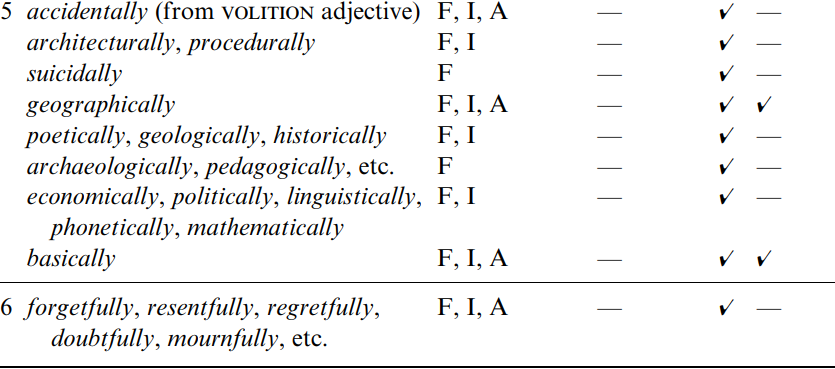
There is a fair degree of fluidity in the placement of these items, in position A and/or I and/or F. others may very well occur, in appropriate discourse and pragmatic contexts. These adverbs fall into six sets.
(1) Those forms—mostly monosyllabic—which can also modify a full NP, from rows (a–g). Alone occurs in position F and I, also in positions A, F and I, while for the remainder A is the favored position—only, even, just, almost, hardly, simply, mainly, merely, chiefly, etc.
(2) Other monomorphemic forms, plus of course. Indeed typically occurs in position I, otherwise in A, generally with comma intonation. The meaning of indeed naturally correlates with the inclusion of emphatic do; for example, Indeed, John did sign the document or John did, indeed, sign the document. Of course may occur in all three positions, always expecting comma intonation. Adverb too is unusual in that it is normally found in F position, as in John laughed too; less often it may be in A position, with comma intonation, as in John, too, laughed.
All the items in set (1), except for alone and also, may also modify an adjective or an adverb. From set (2), indeed and of course lack these functions. Too may be restricted to modification of an adjective which is in copula complement function. When modifying an adjective or an adverb, it generally expects a following qualification; for example, John is too stupid (to be entrusted with this task), and Mary talks too quickly (for foreigners to understand). The items in sets (3)–(6) may all—except, perhaps, for certainly—modify some adjectives. Some of those in sets (4)–(5) may also modify an adverb.
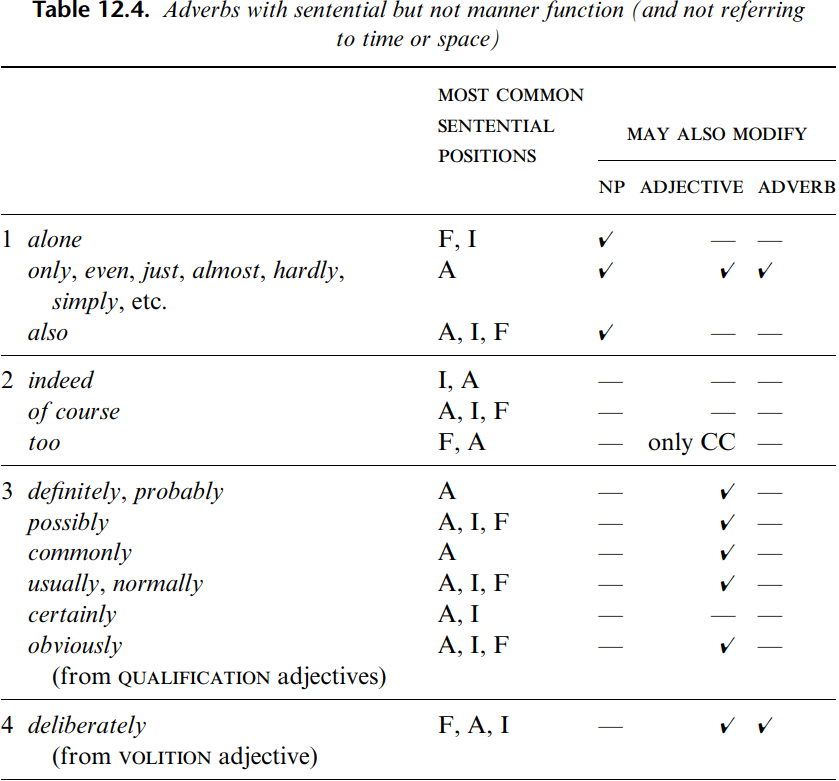
(3) Adverbs derived by the addition of -ly to monomorphemic QUALIFICATION adjectives (save for the CORRECT subtype, whose adverbs have both sentential and manner functions). These always occur in position A and have varying possibilities for positions I, or for I and F. The peripheral positions generally carry a contrastive meaning; compare He’s obviously forgotten (simple statement of inference) with He’s forgotten, obviously (sardonic overtone, ‘what would you expect of him?’).
Note that the adverb truly has a rather different meaning from the adjective true (which is placed in the same adjectival subtype as definite and probable); truly patterns with really. The adjective likely (in the same subtype as certain) does not form an adverb, no doubt due at least in part to the fact that it already ends in -ly.
Negative congeners of these items tend to have somewhat different meanings and syntactic possibilities. Impossibly cannot be substituted for possibly in He may possibly come, nor uncertainly for certainly in He will certainly come. And one cannot substitute possibly or certainly into He behaved impossibly/uncertainly. Indefinitely has limited use (as in postpone indefinitely), rather different from that of definitely. Uncommonly and commonly have some shared possibilities, as in These plants occur commonly/ uncommonly in the savannah. But they also show differences; one cannot substitute commonly into He did uncommonly/well.
(4) Deliberately, from the VOLITION type. This is most at home in position F, but is also found in I and A. Its antonym, accidentally, in set (5), has the same placements, as does purposefully (which could be from either noun purpose or verb purpose, plus -ful to derive an adjective, plus -ly).
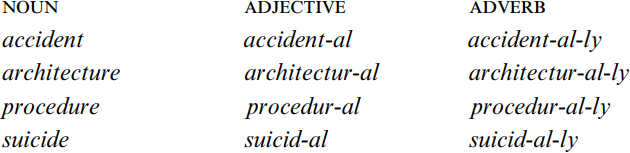
(5) Adverbs which are derived (by the addition of -ly) from already derived adjectives. The first group involves adjectives derived from nouns by the addition of -al. For example:
The second group is based in adjectives ending in -ical, also formed on nouns. For some, but not for others, an intermediate stage of derivation is represented by an adjective ending in -ic. For example:
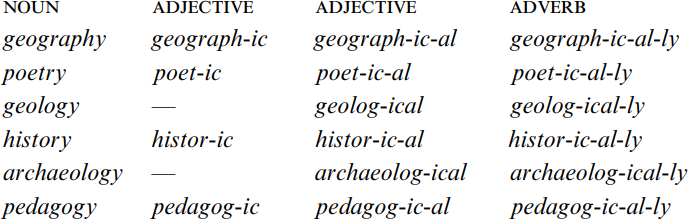
We also find nouns ending in -ics, which drop the -s to form an adjective, add -al to form another adjective and then -ly to derive an adverb; however, for some of them either the -ic form or the -ical form is missing. Examples include:
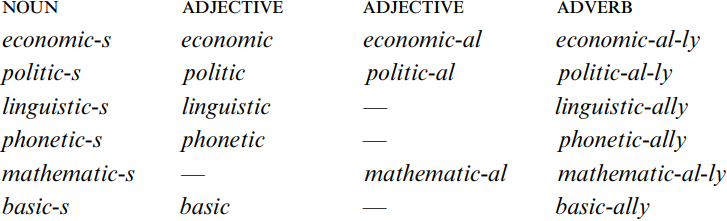
Whereas geographic and geographical, poetic and poetical, and pedagogic and pedagogical have pretty much the same meaning, there is a difference between historic and historical, economic and economical, and politic and political (see any good dictionary). There is a further adverb which involves -ly being added to politic, without the intervening -al. For most speakers today, politically and politicly are variants with the same meaning.
All the items in set (5) typically occur in position F. Their predispositions towards placement at I and A vary. There is also the adverb drastically, derived from adjective drastic (there is no noun drastics); however, this functions as a manner adverb.
(6) Adverbs derived (by -ly) from adjectives which are themselves derived from verbs by the addition of -ful; for example, verb forget, adjective forget-ful, adverb forget-ful-ly. Other base verbs include resent, regret, doubt and mourn. These may occur in all of the three positions, F, I and A.
Whereas adverbs from sets (1)–(4) may, potentially, occur with any type of verb, those in sets (5) and (6) are limited to verbs (and adjectives) with a related meaning; for example, Suicidally, she drove the car at two hundred kilometres an hour, The proposal is not economically viable, and He regretfully declined the invitation.
 الاكثر قراءة في Semantics
 اخر الاخبار
اخبار العتبة العباسية المقدسة

الآخبار الصحية


مواضيع ذات صلة
 قسم الشؤون الفكرية يصدر كتاباً يوثق تاريخ السدانة في العتبة العباسية المقدسة
 "المهمة".. إصدار قصصي يوثّق القصص الفائزة في مسابقة فتوى الدفاع المقدسة للقصة القصيرة
 (نوافذ).. إصدار أدبي يوثق القصص الفائزة في مسابقة الإمام العسكري (عليه السلام)