Grammar
Tenses
Present

Present Simple
Present Continuous
Present Perfect
Present Perfect Continuous
Past
Past Simple
Past Continuous
Past Perfect
Past Perfect Continuous
Future
Future Simple
Future Continuous
Future Perfect
Future Perfect Continuous
Parts Of Speech
Nouns
Countable and uncountable nouns
Verbal nouns
Singular and Plural nouns
Proper nouns
Nouns gender
Nouns definition
Concrete nouns
Abstract nouns
Common nouns
Collective nouns
Definition Of Nouns
Animate and Inanimate nouns
Nouns
Verbs
Stative and dynamic verbs
Finite and nonfinite verbs
To be verbs
Transitive and intransitive verbs
Auxiliary verbs
Modal verbs
Regular and irregular verbs
Action verbs
Verbs
Adverbs
Relative adverbs
Interrogative adverbs
Adverbs of time
Adverbs of place
Adverbs of reason
Adverbs of quantity
Adverbs of manner
Adverbs of frequency
Adverbs of affirmation
Adverbs
Adjectives
Quantitative adjective
Proper adjective
Possessive adjective
Numeral adjective
Interrogative adjective
Distributive adjective
Descriptive adjective
Demonstrative adjective
Pronouns
Subject pronoun
Relative pronoun
Reflexive pronoun
Reciprocal pronoun
Possessive pronoun
Personal pronoun
Interrogative pronoun
Indefinite pronoun
Emphatic pronoun
Distributive pronoun
Demonstrative pronoun
Pronouns
Pre Position
Preposition by function
Time preposition
Reason preposition
Possession preposition
Place preposition
Phrases preposition
Origin preposition
Measure preposition
Direction preposition
Contrast preposition
Agent preposition
Preposition by construction
Simple preposition
Phrase preposition
Double preposition
Compound preposition
prepositions
Conjunctions
Subordinating conjunction
Correlative conjunction
Coordinating conjunction
Conjunctive adverbs
conjunctions
Interjections
Express calling interjection
Phrases
Sentences
Grammar Rules
Passive and Active
Preference
Requests and offers
wishes
Be used to
Some and any
Could have done
Describing people
Giving advices
Possession
Comparative and superlative
Giving Reason
Making Suggestions
Apologizing
Forming questions
Since and for
Directions
Obligation
Adverbials
invitation
Articles
Imaginary condition
Zero conditional
First conditional
Second conditional
Third conditional
Reported speech
Demonstratives
Determiners
Linguistics
Phonetics
Phonology
Linguistics fields
Syntax
Morphology
Semantics
pragmatics
History
Writing
Grammar
Phonetics and Phonology
Semiotics
Reading Comprehension
Elementary
Intermediate
Advanced
Teaching Methods
Teaching Strategies
Assessment

Object nominalizations
 المؤلف:
R.M.W. Dixon
المؤلف:
R.M.W. Dixon
 المصدر:
A Semantic approach to English grammar
المصدر:
A Semantic approach to English grammar
 الجزء والصفحة:
329-10
الجزء والصفحة:
329-10
 2023-04-11
 1496
1496




+
-
20
Object nominalizations
One variety of nominalization, Object-nom, can function as object for the verb from which it is derived—dream a dream (where the Object-nom has the same form as the verb) or pay a payment (where the forms differ). Note that these are not ‘patient’ nominalizations (dream and payment are not patients); they relate to the syntactic function of object, rather than to a semantic role.
As mentioned, such ‘cognate objects’ are in fact seldom used as is, but generally require one or more modifiers which provide significant extra information in the object noun phrase (over and above that conveyed by the verb). For example, I dreamed the horrible and frightening dream (or the first line of a well-known song, To dream the impossible dream) rather than just I dreamt a dream, and He paid the rather steep but unavoidable down-payment on the house rather than just He paid the payment. Here are some examples of Object-nom’s, with sample modifiers:
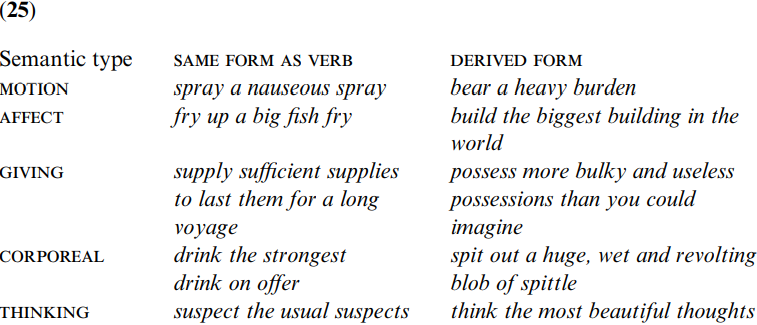
Other Object-nom’s of this type include plant, smoke, sell, taste, feed/ food, favor/favorite, and derivations ending in -ee, such as employee, nominee, appointee. Some nominalizations are used in plural form; for example, supplies in (25) and nibbles, as in I nibbled the most delicious oriental nibbles at that cocktail party. And there are also nominalizations which may be used as peripheral arguments: for example, The American tourist tipped the taxi driver with a most generous tip (and similarly for reward and bribe, among others).
The verbs mentioned so far are fully transitive, with the nominalization available for object (or indirect object) slot as alternative to a non-cognate form; for example, one can say either He drank a black coffee or He drank the strongest drink on offer. As discussed, there are also a number of verbs, most from the CORPOREAL (and a few from the WEATHER) type, which are basically intransitive, and can only be followed by a noun phrase (in apparent object function) when this has an Object-nom as head. For example:

Other verbs of this type include laugh, cough, sneeze, yawn and wink.
Using a verb with an Object-nom, even with heavy modification in the object noun phrase, is not common in formal style. It is probably most acceptable when the nominalization has a derived form, as different as possible from the verb (for example, bear and burden, where the derivation goes back to Old English). But collocations such as those in (25)–(26) are common in colloquial speech and in spoken rhetoric.
An Object-nom is most frequently found with a verb other than that from which it is derived, but with a similar meaning; for example, apply a spray, carry a burden, cook up a fish fry, erect a building.
There are a number of further Object-nom’s which are scarcely likely to function as object of the verb on which they are based, even in the most colloquial speech (although, with ingenuity, contexts could well be devised for them). However, they can be equated (by copula be) with the object of the verb. For example:

Object-nom’s of this type include those formed with -(t)ion (others are selection, proposal and supposition) and convert, discovery, choice. And also view—We viewed the forest from the window implies that The view from the window is the forest.
Some derived forms may function both as a Unit-nom, as in (28a), and as an Object-nom, as in (28b):

However, one cannot have both simultaneously. That is, *John’s gift of [a most generous gift] to Mary . . . is quite unacceptable.
And building, for example, can be an Activity-nom, as in (29a), or an Object-nom, as in (29b):

Again, we cannot have both at once—*John’s building of [a tremendously high building] took a long time is scarcely acceptable.
An Object-nom can generally be in possessive relation with the erstwhile A argument of the verb, if this satisfies the conditions for taking ’s (or if it is a pronoun with animate reference). Besides the examples given in (3) and (5) there are my burden, the rich tourist’s tip, Mary’s thoughts, John’s assumption.
 الاكثر قراءة في Semantics
 اخر الاخبار
اخبار العتبة العباسية المقدسة

الآخبار الصحية


مواضيع ذات صلة
 قسم الشؤون الفكرية يصدر كتاباً يوثق تاريخ السدانة في العتبة العباسية المقدسة
 "المهمة".. إصدار قصصي يوثّق القصص الفائزة في مسابقة فتوى الدفاع المقدسة للقصة القصيرة
 (نوافذ).. إصدار أدبي يوثق القصص الفائزة في مسابقة الإمام العسكري (عليه السلام)