Grammar
Tenses
Present

Present Simple
Present Continuous
Present Perfect
Present Perfect Continuous
Past
Past Simple
Past Continuous
Past Perfect
Past Perfect Continuous
Future
Future Simple
Future Continuous
Future Perfect
Future Perfect Continuous
Parts Of Speech
Nouns
Countable and uncountable nouns
Verbal nouns
Singular and Plural nouns
Proper nouns
Nouns gender
Nouns definition
Concrete nouns
Abstract nouns
Common nouns
Collective nouns
Definition Of Nouns
Animate and Inanimate nouns
Nouns
Verbs
Stative and dynamic verbs
Finite and nonfinite verbs
To be verbs
Transitive and intransitive verbs
Auxiliary verbs
Modal verbs
Regular and irregular verbs
Action verbs
Verbs
Adverbs
Relative adverbs
Interrogative adverbs
Adverbs of time
Adverbs of place
Adverbs of reason
Adverbs of quantity
Adverbs of manner
Adverbs of frequency
Adverbs of affirmation
Adverbs
Adjectives
Quantitative adjective
Proper adjective
Possessive adjective
Numeral adjective
Interrogative adjective
Distributive adjective
Descriptive adjective
Demonstrative adjective
Pronouns
Subject pronoun
Relative pronoun
Reflexive pronoun
Reciprocal pronoun
Possessive pronoun
Personal pronoun
Interrogative pronoun
Indefinite pronoun
Emphatic pronoun
Distributive pronoun
Demonstrative pronoun
Pronouns
Pre Position
Preposition by function
Time preposition
Reason preposition
Possession preposition
Place preposition
Phrases preposition
Origin preposition
Measure preposition
Direction preposition
Contrast preposition
Agent preposition
Preposition by construction
Simple preposition
Phrase preposition
Double preposition
Compound preposition
prepositions
Conjunctions
Subordinating conjunction
Correlative conjunction
Coordinating conjunction
Conjunctive adverbs
conjunctions
Interjections
Express calling interjection
Phrases
Sentences
Grammar Rules
Passive and Active
Preference
Requests and offers
wishes
Be used to
Some and any
Could have done
Describing people
Giving advices
Possession
Comparative and superlative
Giving Reason
Making Suggestions
Apologizing
Forming questions
Since and for
Directions
Obligation
Adverbials
invitation
Articles
Imaginary condition
Zero conditional
First conditional
Second conditional
Third conditional
Reported speech
Demonstratives
Determiners
Linguistics
Phonetics
Phonology
Linguistics fields
Syntax
Morphology
Semantics
pragmatics
History
Writing
Grammar
Phonetics and Phonology
Semiotics
Reading Comprehension
Elementary
Intermediate
Advanced
Teaching Methods
Teaching Strategies
Assessment

Nominalizations denoting unit of activity and activity itself
 المؤلف:
R.M.W. Dixon
المؤلف:
R.M.W. Dixon
 المصدر:
A Semantic approach to English grammar
المصدر:
A Semantic approach to English grammar
 الجزء والصفحة:
323-10
الجزء والصفحة:
323-10
 2023-04-10
 1599
1599




+
-
20
Nominalizations denoting unit of activity and activity itself
Verbs referring to an activity may have one nominalization referring to a unit of activity and another to the activity itself. For example:
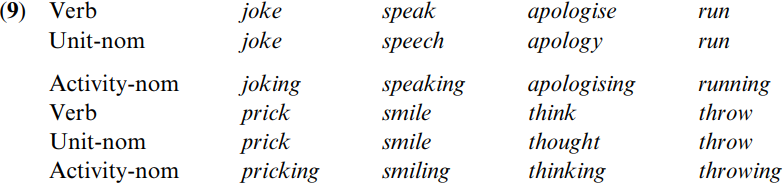
It will be seen that a Unit-nom can have the same form as the verb, or a different form (as in speech, apology, and thought). Activity-nom’s typically end in -ing, although there are other possibilities (for example, resistance, recovery).
Now, the verb in an ING complement clause and an Activity-nom can have the same form, ending in -ing. There is, however, a considerable grammatical deference. Consider:

The object argument of (10a) is a noun phrase with the nominalization throwing as head, whereas the object of (10b) is the complement clause John’s throwing the dice. There is a difference in meaning, with (10b) stating that I criticized the fact that he threw the dice, while (10a) states that I criticized the way in which he threw them.
There are three grammatical criteria for distinguishing between an ING complement clause and a noun phrase with an Activity-nom as head:
(i) In a noun phrase the nominal head can be modified by an adjective (not an adverb); the noun phrase in (10a) could be expanded to John’s lazy throwing of the dice. A complement clause can include an adverb (not an adjective); the complement clause in (10b) could be expanded to John’s lazily throwing the dice or John’s throwing the dice lazily.
(ii) If the verb in a complement clause is transitive, it may be directly followed by an object noun phrase, as throwing the dice in (10b). In contrast, an Activity nom must include of before the noun phrase which was object of the underlying verb, as throwing of the dice in (10a).
(iii) In a noun phrase a possessive modifier can be replaced by the definite article, the—in (10a) we could have the throwing of the dice in place of John’s throwing of the dice. Such a substitution is not possible in a complement clause.
It is important to keep in mind, throughout the discussion which follows, that each -ing form being discussed is a nominalization and not the verb of a complement clause. This can easily be checked by the adjective/adverb test, or the zero/of test, or by the possibility of using an article.
The Unit-nom corresponding to (10a) is:

This again includes of and an adjective rather than an adverb; in addition, the can be substituted for John’s.
There is a semantic difference here; (11) states that John had a single throw of the dice, whereas (10a) implies that he threw the dice more than once, over a period of time. Similar differences apply for each of the nominalization pairs in (9). There can be a Unit-nom run (such as running a race) or an Activity-nom running, referring to a period of activity; just one prick of a pin, or a period of pricking; a single flashing smile, or a continuous period of smiling. And so on.
One must, of course, have a grammatical criterion to justify the decision to recognize distinct varieties of nominalization. A Unit-nom is countable—that is, it can be modified by a number adjective and may take the plural suffix -s. One may say:
(12) (a) There was only one joke/*joking in the whole meeting
(b) John told several jokes/*jokings
Activity-nom’s are not countable. A typical environment for them is after a period of, as in:
(13) There was a period of joking/*joke, then the meeting relapsed into seriousness
But, whereas no Activity-nom is countable, there are a few Unit-nom’s that refer to a unit of activity which is extended in time and can thus occur in the frame ‘a period of—’. Consider Unit-nom conversation and Activity-nom conversing in:
(14) The delegates were conversing seriously
(a) There were [several serious conversations/*conversings] going on at the same time
(b) There was [a period of [serious conversation]]
(c) There was [a period of [serious conversing]]
Sentence (14b) implies that there was a unit of conversation (with a beginning and an end) extending over a fair period of time, whereas (14c) states that the delegates conversed for a while, with this perhaps gradually blending into some other activity (maybe drinking or sleeping).
Leaving aside LIKING, ANNOYING, COMPARING and RELATING, and the Secondary-D types, every semantic type includes some verbs which form a Unit-nom or an Activity-nom. The subject argument of the verb can generally be a pronoun or a human (or animate) noun with specific, singular reference, and may then function as possessor to the nominalization, marked by ’s (or by the possessive form of a pronoun). Examples include:
. Primary-A, AFFECT type. John cold-bloodedly shot the dog, giving nominalization [John’s cold-blooded shooting of the dog] amazed the priest.
. Primary-B, ATTENTION type. Little Johnny cheekily tasted the brandy, giving nominalization [Little Johnny’s cheeky tasting of the brandy] got him into trouble.
. Secondary-A, TRYING type. Bill eagerly attempted to solve the problem, giving nominalization [Bill’s eager attempt to solve the problem] proved fruitless.
. Secondary-B, WANTING type. Matilda desperately wished to get married, giving nominalization [Matilda’s desperate wish to get married] was satisfied.
. Secondary-C, HELPING type. Mary supported John unstintingly, giving nominalization [Mary’s unstinting support of John] helped him through the crisis.
It is possible to have a subject argument which does not satisfy (or scarcely satisfies) the criterion for attachment of possessive marker ’s, so that of may be preferred (although ’s and of are likely both to be possible). For example:
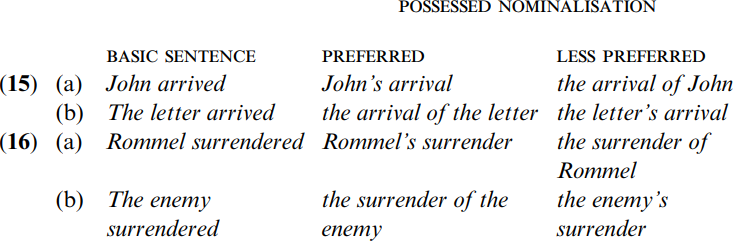
If an O argument satisfies the conditions to take ’s, then it too may be marked as possessor to a Unit-nom or Activity-nom, as an alternative to the A argument being so marked. This is illustrated in (6) and (7). In many cases the O argument is not a pronoun or a noun with human (or animate), specific, singular reference, and is thus not eligible to take ’s. As stated before, the alternative in such cases is of. Example (6), repeated here as (17), describes the teacher’s whipping the boy. One can also whip cream. Compare:
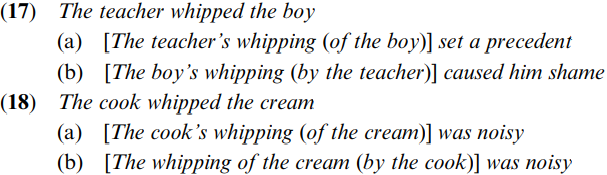
Should we consider the whipping of the cream in (18b) as the equivalent of the boy’s whipping in (17b)? There is an alternative. One of the criteria for distinguishing between a complement clause and an Activity-nom or a Unit-nom is that, in the nominalization, the erstwhile O is preceded by of and a possessive modifier may be replaced by the. In (18a) we have the cook’s whipping of the cream. Substituting the for the cook’s gives the whipping of the cream, as in (18b). That is, the cook’s whipping of the cream can be analyzed in either of two ways:
. (i) As an O-possessed Activity-nom, corresponding to the boy’s whipping in (6b) but with of in place of ’s due to the nature of the referent of the O argument.
. (ii) As a reduction of the A-possessed Activity-nom, The cook’s whipping of the cream, in (18a), with the replacing the cook’s.
The alternative analyses carry the same meaning, and there seems no reason to prefer one over the other.
 الاكثر قراءة في Semantics
 اخر الاخبار
اخبار العتبة العباسية المقدسة

الآخبار الصحية


مواضيع ذات صلة
 قسم الشؤون الفكرية يصدر كتاباً يوثق تاريخ السدانة في العتبة العباسية المقدسة
 "المهمة".. إصدار قصصي يوثّق القصص الفائزة في مسابقة فتوى الدفاع المقدسة للقصة القصيرة
 (نوافذ).. إصدار أدبي يوثق القصص الفائزة في مسابقة الإمام العسكري (عليه السلام)