Grammar
Tenses
Present

Present Simple
Present Continuous
Present Perfect
Present Perfect Continuous
Past
Past Simple
Past Continuous
Past Perfect
Past Perfect Continuous
Future
Future Simple
Future Continuous
Future Perfect
Future Perfect Continuous
Parts Of Speech
Nouns
Countable and uncountable nouns
Verbal nouns
Singular and Plural nouns
Proper nouns
Nouns gender
Nouns definition
Concrete nouns
Abstract nouns
Common nouns
Collective nouns
Definition Of Nouns
Animate and Inanimate nouns
Nouns
Verbs
Stative and dynamic verbs
Finite and nonfinite verbs
To be verbs
Transitive and intransitive verbs
Auxiliary verbs
Modal verbs
Regular and irregular verbs
Action verbs
Verbs
Adverbs
Relative adverbs
Interrogative adverbs
Adverbs of time
Adverbs of place
Adverbs of reason
Adverbs of quantity
Adverbs of manner
Adverbs of frequency
Adverbs of affirmation
Adverbs
Adjectives
Quantitative adjective
Proper adjective
Possessive adjective
Numeral adjective
Interrogative adjective
Distributive adjective
Descriptive adjective
Demonstrative adjective
Pronouns
Subject pronoun
Relative pronoun
Reflexive pronoun
Reciprocal pronoun
Possessive pronoun
Personal pronoun
Interrogative pronoun
Indefinite pronoun
Emphatic pronoun
Distributive pronoun
Demonstrative pronoun
Pronouns
Pre Position
Preposition by function
Time preposition
Reason preposition
Possession preposition
Place preposition
Phrases preposition
Origin preposition
Measure preposition
Direction preposition
Contrast preposition
Agent preposition
Preposition by construction
Simple preposition
Phrase preposition
Double preposition
Compound preposition
prepositions
Conjunctions
Subordinating conjunction
Correlative conjunction
Coordinating conjunction
Conjunctive adverbs
conjunctions
Interjections
Express calling interjection
Phrases
Sentences
Grammar Rules
Passive and Active
Preference
Requests and offers
wishes
Be used to
Some and any
Could have done
Describing people
Giving advices
Possession
Comparative and superlative
Giving Reason
Making Suggestions
Apologizing
Forming questions
Since and for
Directions
Obligation
Adverbials
invitation
Articles
Imaginary condition
Zero conditional
First conditional
Second conditional
Third conditional
Reported speech
Demonstratives
Determiners
Linguistics
Phonetics
Phonology
Linguistics fields
Syntax
Morphology
Semantics
pragmatics
History
Writing
Grammar
Phonetics and Phonology
Semiotics
Reading Comprehension
Elementary
Intermediate
Advanced
Teaching Methods
Teaching Strategies
Assessment

S = O pairs: which is basic?
 المؤلف:
R.M.W. Dixon
المؤلف:
R.M.W. Dixon
 المصدر:
A Semantic approach to English grammar
المصدر:
A Semantic approach to English grammar
 الجزء والصفحة:
309-9
الجزء والصفحة:
309-9
 2023-04-08
 1451
1451




+
-
20
S = O pairs: which is basic?
For almost all verbs that show dual transitivity on the S = A pattern, native speakers have a clear intuition that the transitive use is prior, i.e. they consider knit, saw, eat, remember, know and help to be basically transitive verbs, which may also be used intransitively.
For most verbs with dual transitivity on the S = O pattern, native speakers consider the intransitive sense to be prior (e.g. The horse trotted around the park, My leg hurt) and the transitive to be a secondary, causative sense (e.g. I trotted the horse around the park, John hurt my leg). This applies to:
- march, run, walk, fly, swim, shake from the RUN subtype, and return from the ARRIVE subtype, of MOTION;
- sit, stand, lie, float, lean from the SIT subtype, and settle from the STAY subtype, of REST;
- wake(n), grow, hurt, bleed from CORPOREAL;
- work from SOCIAL CONTRACT;
- race from COMPETITION.
(It appears that the only true transitive verbs which may be used causatively are the Secondary-A forms start, stop, keep, begin, hurry and hasten, e.g. The workmen started laying the tiles this morning, I started the workmen laying the tiles this morning . Native speakers regard the non-causative use of these verbs as basic.)
There are a number of verbs from the DROP subtype of MOTION and from the BREAK and STRETCH subtypes of AFFECT which have dual transitivity on the S = O pattern:
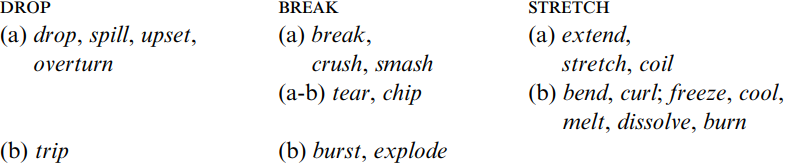
Native speakers consider certain of these verbs to be basically intransitive, and certain of them to be basically transitive; for others it is difficult to assign priority to either transitivity value.
Thus, from the BREAK subtype, break, crush and smash are considered basically transitive, burst and explode basically intransitive, with tear and chip some way in between. Similarly, drop, spill, upset and overturn are considered basically transitive but trip basically intransitive; and extend, stretch, coil basically transitive but bend, curl and freeze, cool, melt, dissolve and burn basically intransitive. (Note that native speaker intuitions vary a little from person to person, and some are stronger than others.)
The principle in operation here appears to be: if the S/O role often gets into the state described by the activity on its own, without outside assistance, then the verb is thought to be basically intransitive. But if one would normally expect there to be a Causer (even if one might not know who or what it is) then the verb is thought to be basically transitive. A person can trip without anyone else being around—so trip is regarded as an intransitive verb, with derived causative sense. But if a liquid spills it is normally someone’s fault—the basic construction for this verb is transitive, although it may also be used intransitively. (The liquid spilled is normally used to disclaim responsibility, in a rather disingenuous way; cf. construction type III for AFFECT verbs, e.g. Oh, did my stick hit you? In each case the Causer/Agent is omitted.) Similarly, things may readily burst (a bubble or a balloon) or explode (a nut that falls into the fire) without any human intervention. Something may break by itself (e.g. the bough of a tree, as it becomes old and dry) but for most instances of breaking a human agent is involved.
Some verbs pose additional problems due to special syntactic or semantic features. Open and close are used as transitive verbs, but in non-transitive constructions one most frequently finds the related adjectives open and closed (e.g. The door is open), although intransitive use of the verbs is also possible (The door opened silently). The verb return is regarded as basically intransitive, and the S NP is likely to be a human (e.g. The librarian returned to work today); when it is used transitively the O NP is likely to be inanimate (e.g. John returned the book to the library). Settle is another verb described as basically intransitive; the S NP can be any human or animal. But it may also be used transitively, and then the A NP is likely to be someone in a position of authority, e.g. The nurse settled all the sick children down for the night, and The Italian government has now settled the farmers in the north Strip.
Worry, grieve and delight are transitive verbs in the ANNOYING type, e.g. Mary’s staying out late every night worries Granny. They can be used in the passive, e.g. Granny is/gets worried by Mary’s staying out late every night. But they may also—unlike most other ANNOYING verbs—be used intransitively, e.g. Granny worries a lot (over/about Mary’s staying out late every night). When asked about worry, native speakers do not have any strong intuition that either of the transitive and intransitive senses is more basic than the other.
Finally, we can note that the set of verbs which have dual transitivity of type S = A and the set which have dual transitivity of type S = O are not mutually exclusive. At least some verbs from the RUN subtype of MOTION enter into pairs of both kinds, e.g. That horse (S) jumped over the gate, That horse (A) jumped the gate (O), and John (A) jumped the horse (O) over the gate (but notice that the preposition over cannot be omitted from the causative, even if it is a significant piece of jumping—one can say John jumped the gate, but not *John jumped the horse the gate). A sentence like M jumped the N is potentially ambiguous between (i) M being the Causer and N the Moving role; and (ii) M being the Moving and N the Locus role. In fact the choice of NPs is likely to provide disambiguation, e.g. the Causer is generally HUMAN and an inanimate NP can only be Locus, so that The horse jumped the gate must be (ii) and John jumped the horse is most likely to be (i).
 الاكثر قراءة في Semantics
 اخر الاخبار
اخبار العتبة العباسية المقدسة

الآخبار الصحية


مواضيع ذات صلة
 قسم الشؤون الفكرية يصدر كتاباً يوثق تاريخ السدانة في العتبة العباسية المقدسة
 "المهمة".. إصدار قصصي يوثّق القصص الفائزة في مسابقة فتوى الدفاع المقدسة للقصة القصيرة
 (نوافذ).. إصدار أدبي يوثق القصص الفائزة في مسابقة الإمام العسكري (عليه السلام)