Grammar
Tenses
Present

Present Simple
Present Continuous
Present Perfect
Present Perfect Continuous
Past
Past Simple
Past Continuous
Past Perfect
Past Perfect Continuous
Future
Future Simple
Future Continuous
Future Perfect
Future Perfect Continuous
Parts Of Speech
Nouns
Countable and uncountable nouns
Verbal nouns
Singular and Plural nouns
Proper nouns
Nouns gender
Nouns definition
Concrete nouns
Abstract nouns
Common nouns
Collective nouns
Definition Of Nouns
Animate and Inanimate nouns
Nouns
Verbs
Stative and dynamic verbs
Finite and nonfinite verbs
To be verbs
Transitive and intransitive verbs
Auxiliary verbs
Modal verbs
Regular and irregular verbs
Action verbs
Verbs
Adverbs
Relative adverbs
Interrogative adverbs
Adverbs of time
Adverbs of place
Adverbs of reason
Adverbs of quantity
Adverbs of manner
Adverbs of frequency
Adverbs of affirmation
Adverbs
Adjectives
Quantitative adjective
Proper adjective
Possessive adjective
Numeral adjective
Interrogative adjective
Distributive adjective
Descriptive adjective
Demonstrative adjective
Pronouns
Subject pronoun
Relative pronoun
Reflexive pronoun
Reciprocal pronoun
Possessive pronoun
Personal pronoun
Interrogative pronoun
Indefinite pronoun
Emphatic pronoun
Distributive pronoun
Demonstrative pronoun
Pronouns
Pre Position
Preposition by function
Time preposition
Reason preposition
Possession preposition
Place preposition
Phrases preposition
Origin preposition
Measure preposition
Direction preposition
Contrast preposition
Agent preposition
Preposition by construction
Simple preposition
Phrase preposition
Double preposition
Compound preposition
prepositions
Conjunctions
Subordinating conjunction
Correlative conjunction
Coordinating conjunction
Conjunctive adverbs
conjunctions
Interjections
Express calling interjection
Phrases
Sentences
Grammar Rules
Passive and Active
Preference
Requests and offers
wishes
Be used to
Some and any
Could have done
Describing people
Giving advices
Possession
Comparative and superlative
Giving Reason
Making Suggestions
Apologizing
Forming questions
Since and for
Directions
Obligation
Adverbials
invitation
Articles
Imaginary condition
Zero conditional
First conditional
Second conditional
Third conditional
Reported speech
Demonstratives
Determiners
Linguistics
Phonetics
Phonology
Linguistics fields
Syntax
Morphology
Semantics
pragmatics
History
Writing
Grammar
Phonetics and Phonology
Semiotics
Reading Comprehension
Elementary
Intermediate
Advanced
Teaching Methods
Teaching Strategies
Assessment

Word derivations
 المؤلف:
R.M.W. Dixon
المؤلف:
R.M.W. Dixon
 المصدر:
A Semantic approach to English grammar
المصدر:
A Semantic approach to English grammar
 الجزء والصفحة:
56-2
الجزء والصفحة:
56-2
 2023-03-13
 2152
2152




+
-
20
Word derivations
English has a number of derivational affixes that change word-class membership, but each applies to a limited set of words. Nouns formed from verbs include amusement, punishment; suggestion, conclusion; blessing, singing; resemblance; pleasure; Among adjectives derived from verbs are adorable, persuasive, contributory. Verbs derived from adjectives and nouns include purify, glorify; equalize, itemize; blacken, lighten, threaten. Most of these derivational endings are of French or Latin origin (notable exceptions being -en and -ing).
Quite a number of English words appear to belong to more than one word class, e.g.
adjective and verb: dirty, clean, tidy, narrow
noun and verb: stone, butter, bridge, cash
verb and noun: walk, punch, look, sleep, catch, laugh, roast
In each case, speakers have a clear intuition that one word-class membership is primary and the other secondary. Stone is said to be firstly a noun, although it can also be used as a verb (e.g. Stone the Christians!). Walk is regarded as a verb, which can also be used as a noun (That walk tired me out). In the tabulation just given, the primary word-class membership is given first (as, indeed, it generally is in dictionary entries).
There are two ways of dealing with the facts reported in the last paragraph. One is to say that stone, butter, etc. are nouns pure and simple, while walk, punch, etc. are verbs, and then to state that all nouns may be head of an NP, but a subset of nouns (stone, butter, etc.) may also function as head of a VP (taking appropriate verbal endings); and that all verbs can be head of a VP but that a specified subset of verbs (walk, punch, etc.) can also be NP head (and will then take appropriate nominal endings). The other approach is to say that the head of a VP can only be a verb, etc., and that English has derivational processes, with ZERO marking, that derive verbs from some nouns (verb stone from noun stone), and so on.
Evidence for preferring the second (zero derivation) alternative in the case of English comes from considerations of pairs like:
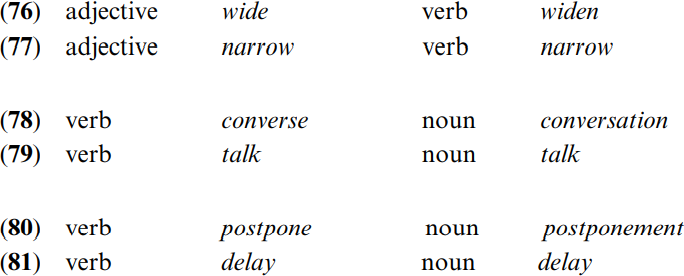
The words in each pair have related meanings. In each instance the first line shows an affix marking a derivational process. By analogy, it seems most satisfactory to say that the second line also involves a derivational process, with zero marking.
A further piece of evidence comes from examination of which words in a given semantic set may have double class membership. Consider:
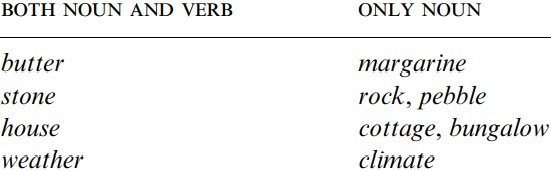
It will be seen that, in each row, the most generic and commonly used noun also undergoes zero derivation to function as a verb, while those with more specific meanings lack this derivation.
In summary, English lacks a full array of productive derivational affixes; the suffixes (mostly of foreign origin) that are used each occur with a restricted set of roots. As a result there is much use of ‘zero derivation’, i.e. use of a noun in verb function without any change in form, etc.
Some generalizations are possible. Many verbs referring to CORPOREAL function can also be used as nouns, e.g. bite, swallow, drink, sniff, smell, taste, laugh, cry, sob, weep, wink, kiss, hug, pee. And many nouns referring to implements can also be used as verbs, e.g. spear, knife, saw, hammer, whip, nail, screw.
We will provide a full discussion of the eight types of nominalizations from verbs, and their markings—zero derivation, and also suffixes -er, -ant, -ard, -ing, -ation, -ment, -ance, etc. (Most suffixes mark several different kinds of nominalization, with different verbs.)
 الاكثر قراءة في Semantics
 اخر الاخبار
اخبار العتبة العباسية المقدسة

الآخبار الصحية


مواضيع ذات صلة
 قسم الشؤون الفكرية يصدر كتاباً يوثق تاريخ السدانة في العتبة العباسية المقدسة
 "المهمة".. إصدار قصصي يوثّق القصص الفائزة في مسابقة فتوى الدفاع المقدسة للقصة القصيرة
 (نوافذ).. إصدار أدبي يوثق القصص الفائزة في مسابقة الإمام العسكري (عليه السلام)