Grammar
Tenses
Present

Present Simple
Present Continuous
Present Perfect
Present Perfect Continuous
Past
Past Simple
Past Continuous
Past Perfect
Past Perfect Continuous
Future
Future Simple
Future Continuous
Future Perfect
Future Perfect Continuous
Parts Of Speech
Nouns
Countable and uncountable nouns
Verbal nouns
Singular and Plural nouns
Proper nouns
Nouns gender
Nouns definition
Concrete nouns
Abstract nouns
Common nouns
Collective nouns
Definition Of Nouns
Animate and Inanimate nouns
Nouns
Verbs
Stative and dynamic verbs
Finite and nonfinite verbs
To be verbs
Transitive and intransitive verbs
Auxiliary verbs
Modal verbs
Regular and irregular verbs
Action verbs
Verbs
Adverbs
Relative adverbs
Interrogative adverbs
Adverbs of time
Adverbs of place
Adverbs of reason
Adverbs of quantity
Adverbs of manner
Adverbs of frequency
Adverbs of affirmation
Adverbs
Adjectives
Quantitative adjective
Proper adjective
Possessive adjective
Numeral adjective
Interrogative adjective
Distributive adjective
Descriptive adjective
Demonstrative adjective
Pronouns
Subject pronoun
Relative pronoun
Reflexive pronoun
Reciprocal pronoun
Possessive pronoun
Personal pronoun
Interrogative pronoun
Indefinite pronoun
Emphatic pronoun
Distributive pronoun
Demonstrative pronoun
Pronouns
Pre Position
Preposition by function
Time preposition
Reason preposition
Possession preposition
Place preposition
Phrases preposition
Origin preposition
Measure preposition
Direction preposition
Contrast preposition
Agent preposition
Preposition by construction
Simple preposition
Phrase preposition
Double preposition
Compound preposition
prepositions
Conjunctions
Subordinating conjunction
Correlative conjunction
Coordinating conjunction
Conjunctive adverbs
conjunctions
Interjections
Express calling interjection
Phrases
Sentences
Grammar Rules
Passive and Active
Preference
Requests and offers
wishes
Be used to
Some and any
Could have done
Describing people
Giving advices
Possession
Comparative and superlative
Giving Reason
Making Suggestions
Apologizing
Forming questions
Since and for
Directions
Obligation
Adverbials
invitation
Articles
Imaginary condition
Zero conditional
First conditional
Second conditional
Third conditional
Reported speech
Demonstratives
Determiners
Linguistics
Phonetics
Phonology
Linguistics fields
Syntax
Morphology
Semantics
pragmatics
History
Writing
Grammar
Phonetics and Phonology
Semiotics
Reading Comprehension
Elementary
Intermediate
Advanced
Teaching Methods
Teaching Strategies
Assessment

Main clauses
 المؤلف:
R.M.W. Dixon
المؤلف:
R.M.W. Dixon
 المصدر:
A Semantic approach to English grammar
المصدر:
A Semantic approach to English grammar
 الجزء والصفحة:
27-2
الجزء والصفحة:
27-2
 2023-03-10
 1743
1743




+
-
20
Main clauses
Each main clause has an ‘argument governor’ (which is the predicate) and one or more ‘arguments’, which are in grammatical relationship to the governor. English has three varieties of main clause, as shown in Table 2.3.
In each clause type, the predicate is a verb phrase and each argument is a noun phrase. As the term ‘predicate’ is used here, it does not include an NP. For example, in John will be interviewing Mary, the predicate is will be interviewing (not will be interviewing Mary); and in Mary was a good dancer the predicate is simply was (not was a good dancer).
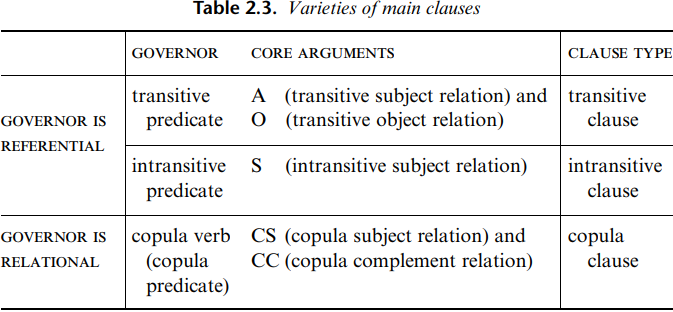
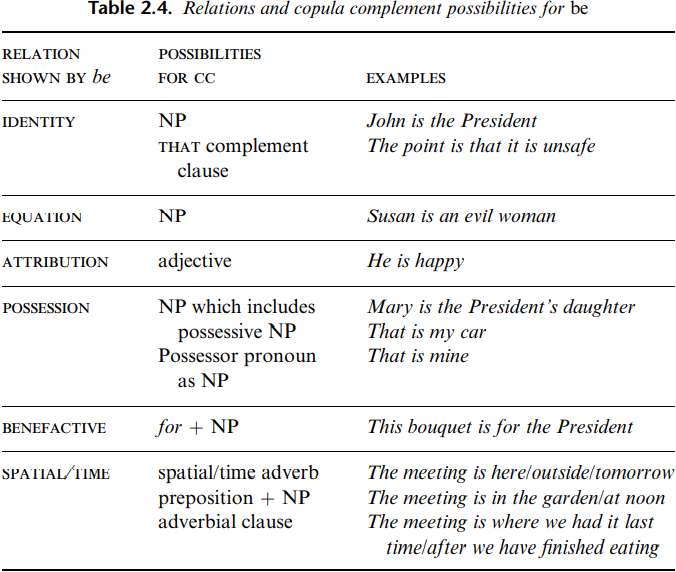
All NPs have reference to a concrete or abstract entity (for example, the tall woman or sincerity), and all transitive and intransitive VCs have reference to a concrete or abstract activity or state (for example, fall or kick or like). In contrast, a copula expresses a relation between the CS and CC arguments. And whereas A, O, S and CS are realized by NPs with essentially the same structure, the possibilities for CC are somewhat different. By far the most common copula in English is be; the possibilities for its CC are set out in Table 2.4.
Many languages require a verb of rest or motion to be included with a locational expression, saying something like She is staying in Prague or She is going to Vienna. English can use just the copula to describe a position of rest, e.g. She is in Prague; but a verb of motion must normally be included with any specification of motion ‘to’ or ‘from’—that is, going cannot be omitted from She is going to Prague. There is an interesting exception: the ‘previous’ auxiliary have plus copula be can be used with a to phrase, without a verb of motion, e.g. She has been to Prague (with the meaning ‘she went to Prague at least once’).
The other copula verbs in English include become, which can be followed by (i) an NP, or (ii) an adjective (She became a doctor/my wife/sick) and get, come, go, grow, turn, feel, each of which may only be followed by a restricted set of adjectives, e.g. get dirty, come true, go bad, grow stupid, turn green. Whereas become only functions as a copula and be only as copula and in the imperfective and passive auxiliaries, the other five also have non-copula uses; indeed, their lexical and copula uses can merge— compare He turned/grew sad with He turned/grew into a sad man.
A main clause in English generally includes a subject, which precedes the predicate. Intransitive verbs have a single core role and this must be intransitive subject (referred to as ‘S’ relation). Transitive verbs have two or more core roles, and that role which is most likely to be relevant for the success of the activity is in transitive subject relation (referred to as ‘A’).
A transitive verb must also have a role in object (O) relation, and this will immediately follow the predicate. After an intransitive predicate, or a transitive-predicate-plus-object or a copula-predicate-plus-copula complement, a clause may include one or more peripheral NPs (each introduced by a preposition), referring to recipient (give the book to Mary), or beneficiary (take the book for Mary), or instrument (shave with a razor), or reason (do it for money/kicks) etc.; and also one or more spatial or time or frequency or manner expressions .
 الاكثر قراءة في Semantics
 اخر الاخبار
اخبار العتبة العباسية المقدسة

الآخبار الصحية


مواضيع ذات صلة
 قسم الشؤون الفكرية يصدر كتاباً يوثق تاريخ السدانة في العتبة العباسية المقدسة
 "المهمة".. إصدار قصصي يوثّق القصص الفائزة في مسابقة فتوى الدفاع المقدسة للقصة القصيرة
 (نوافذ).. إصدار أدبي يوثق القصص الفائزة في مسابقة الإمام العسكري (عليه السلام)