Verb and verb phrase
We first examine the forms of the verb, and the elements which can make up a verb phrase, before setting out the systems of mood, reality status, modality, tense and aspect which underlie the English predicate, and the way in which the terms in these systems are marked.
Forms of the verb
It is important to distinguish between the base form of a verb, the three tense forms, and the two non-tense suffixed forms. Illustrating for one regular and three sample irregular verbs:
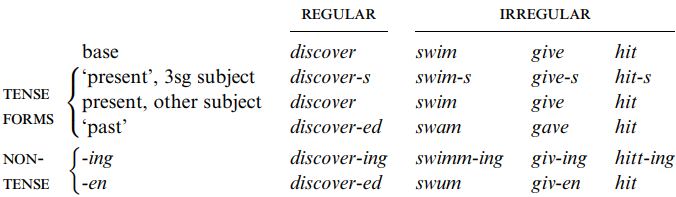
Be (base form) is the most irregular verb, with am for 1sg subject, is for 3sg m, f and n and are elsewhere in present; was for 1sg and 3sg m, f and n and were elsewhere in the past; plus being and been. All other verbs are regular for present and the -ing form; irregularities are found for irregular verbs in past tense and in the -en form.
The tense forms are used in main clauses and must be preceded by a subject (at the least, the impersonal subject, it); the only circumstance in which a subject can be omitted is when two clauses with identical subject are coordinated, e.g. John came in and sat down. The base form is used in the imperative, and after to (the misnamed ‘infinitive’).
Non-tense forms are used after auxiliary verbs: -ing after ‘imperfective’ be; -en after ‘previous’ have and after passive be (e.g. was giving; had given, was given). In addition, -ing is used in varieties of complement clause, one often with’s on the subject (if it is stated), e.g. I like Mary(’s) playing the piano; the other with from between subject and verb, e.g. I discouraged John from going. It can also mark the predicate of a circumstantial clause, e.g. Having made his will, he shot himself, and Being absorbed in her task, she didn’t notice the tiger approach. Both -ing and -en forms may also function as adjectival modifiers within an NP, although only some verbs have (one or both of) their non-tense forms used in this way, e.g. worrying news, worried expression, helping hand, informed reply, swum distance.
Unlike tense forms, the non-tense forms do not have to be preceded by a stated subject within that clause, e.g. I like playing the piano, and the two circumstantial clauses given in the last paragraph.
(nouns can be derived from some verbs and this sometimes involves the addition of -ing, e.g. the singing of the birds, the rocking of the boat. But with many verbs a different derivational form is used, e.g. the departure of the army, rather than *departing, and decision not *deciding, belief not *believing, etc. Or the same form can be used for verb base and noun, e.g. laugh, bite, witness.)
It is informative to compare the past tense form, which must have a preceding subject, with the -en form, which may lack a stated subject. Compare:
(1) All students [(who were) seen in the bar last night] should report to the principal’s office at noon
(2) All teachers [who saw students in the bar last night] should report to the principal’s office at noon
The relative clause in (1) can be shortened by the omission of who (a relative pronoun filling subject slot) and were; the non-tense form seen then becomes clause-initial. Who cannot be omitted from (2); this is because the past tense form saw must be preceded by a subject.
For all regular (and some irregular) verbs the -en and past tense forms fall together—both seen in (1) and saw in (2) could be replaced by discovered. For these verbs it is important to enquire whether a form like discovered is, in a particular clause, realizing the past tense category (since it will then require a subject) or the -en category (when it will have different syntactic possibilities); if discovered is substituted for seen in (1) and for saw in (2), then we can still omit who were from (1) but not who from (2). This is parallel to the situation concerning those few nouns that have a single form for both singular and plural—there is still an operative category of number, which is realized in the form of accompanying demonstrative and verb; compare this sheep is bleating with these sheep are bleating (this versus these and is versus are showing that sheep once realizes singular and once plural number).
All verbs (except be) have a present non-3sg form that is identical to the base form. Once again, we must know what category a plain verb form is representing in a given clause. Compare I know all about your children; they eat ice cream and I said to your children: ‘(you) eat this ice cream!’ The pronoun they cannot be omitted from the first sentence since the tensed verb eat must be preceded by a subject; but the subject pronoun you can be omitted from the second sentence since the base form eat (here, in imperative function) does not require a preceding subject.








