Grammar
Tenses
Present

Present Simple
Present Continuous
Present Perfect
Present Perfect Continuous
Past
Past Simple
Past Continuous
Past Perfect
Past Perfect Continuous
Future
Future Simple
Future Continuous
Future Perfect
Future Perfect Continuous
Parts Of Speech
Nouns
Countable and uncountable nouns
Verbal nouns
Singular and Plural nouns
Proper nouns
Nouns gender
Nouns definition
Concrete nouns
Abstract nouns
Common nouns
Collective nouns
Definition Of Nouns
Animate and Inanimate nouns
Nouns
Verbs
Stative and dynamic verbs
Finite and nonfinite verbs
To be verbs
Transitive and intransitive verbs
Auxiliary verbs
Modal verbs
Regular and irregular verbs
Action verbs
Verbs
Adverbs
Relative adverbs
Interrogative adverbs
Adverbs of time
Adverbs of place
Adverbs of reason
Adverbs of quantity
Adverbs of manner
Adverbs of frequency
Adverbs of affirmation
Adverbs
Adjectives
Quantitative adjective
Proper adjective
Possessive adjective
Numeral adjective
Interrogative adjective
Distributive adjective
Descriptive adjective
Demonstrative adjective
Pronouns
Subject pronoun
Relative pronoun
Reflexive pronoun
Reciprocal pronoun
Possessive pronoun
Personal pronoun
Interrogative pronoun
Indefinite pronoun
Emphatic pronoun
Distributive pronoun
Demonstrative pronoun
Pronouns
Pre Position
Preposition by function
Time preposition
Reason preposition
Possession preposition
Place preposition
Phrases preposition
Origin preposition
Measure preposition
Direction preposition
Contrast preposition
Agent preposition
Preposition by construction
Simple preposition
Phrase preposition
Double preposition
Compound preposition
prepositions
Conjunctions
Subordinating conjunction
Correlative conjunction
Coordinating conjunction
Conjunctive adverbs
conjunctions
Interjections
Express calling interjection
Phrases
Sentences
Grammar Rules
Passive and Active
Preference
Requests and offers
wishes
Be used to
Some and any
Could have done
Describing people
Giving advices
Possession
Comparative and superlative
Giving Reason
Making Suggestions
Apologizing
Forming questions
Since and for
Directions
Obligation
Adverbials
invitation
Articles
Imaginary condition
Zero conditional
First conditional
Second conditional
Third conditional
Reported speech
Demonstratives
Determiners
Linguistics
Phonetics
Phonology
Linguistics fields
Syntax
Morphology
Semantics
pragmatics
History
Writing
Grammar
Phonetics and Phonology
Semiotics
Reading Comprehension
Elementary
Intermediate
Advanced
Teaching Methods
Teaching Strategies
Assessment

Pronouns
 المؤلف:
R.M.W. Dixon
المؤلف:
R.M.W. Dixon
 المصدر:
A Semantic approach to English grammar
المصدر:
A Semantic approach to English grammar
 الجزء والصفحة:
19-2
الجزء والصفحة:
19-2
 2023-03-06
 1918
1918




+
-
20
Pronouns
The pronoun system of English, at the beginning of the twenty-first century, is shown in Table 2.1. Pronouns in series I are likely to reduce to enclitics, while series II and possessor modifier forms are likely to reduce to proclitics.
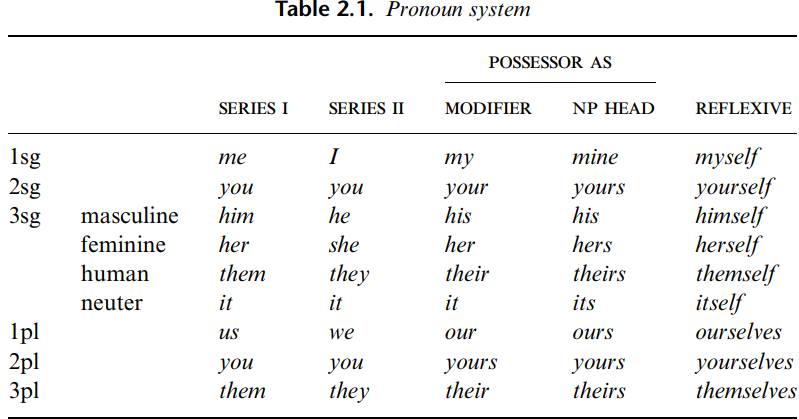
In an earlier stage of English the function of an NP in a clause was shown by its case ending—nominative for subject, and accusative for object; there was then considerable freedom of word order. The case endings on nouns and adjectives have been lost and in modern English the function of an NP is generally shown by its place in order—subject before and object after the predicate in a simple clause. However, the pronouns—except for you and it—still retain two case forms, series I and II.
Series I are the ‘unmarked’ forms. Series II occurs only in subject function (as in I went), except following a preposition; in John brought the applicants in for me to interview them, me is subject of interview but also follows the preposition for, and here takes a series I form. Series I occurs in all other positions—when object of a clause (for example, watch me), following a preposition (as in after me) and when making up a whole clause. If someone asks Who wants to go?, one could reply either I do (here using a series II form as subject of the verb do) or else just the series I form Me (but not just the series II form *I).
When a pronoun is conjoined with a noun, in subject position, then the pronoun has series II form only when it immediately precedes the verb, as in John and I went. If the pronoun occurs first in the conjunction, then a series I form is required; one can only say Me and John went, not *I and John went. (In object position, series I is always used: He saw me and John and He saw John and me.) A pronoun will not usually be modified by an adjective, but when this does happen it is the series I form that must be used; one says Lucky me won the lottery, not *Lucky I won the lottery.
There is a fair degree of variation in pronominal use. Some people still say It was I who did it, She is younger than I, and It is I, where most speakers would prefer me in place of I in all three sentences. There appears to be a long-term trend towards the replacement of series II by series I (this has gone all the way with the second person pronoun where you, the original object form, has entirely replaced the old subject form ye).
In some complex constructions an NP may come between two verbs, e.g. I know John took the ball and I saw John take the ball. We may ask whether, in these sentences, John is object of the verb it follows, or subject of the verb it precedes, or both of these simultaneously. On substituting a pronoun for John we get different results: I know he took the ball and I saw him take the ball.
This information from pronominal forms is one important factor in deciding on the function of an NP in a complex sentence. We can infer that John is the subject of took in the first example, and the object of saw in the second. John may well also be object of know and/or subject of take (respectively), with other grammatical factors deciding which of two simultaneous functions determines surface form. Data on pronominal form do not provide an immediate and total answer to the question we posed in the last paragraph, but they are a most useful element in the formulation of a full answer.
During the past couple of decades, a new row has been added to the pronoun paradigm. For hundreds of years, he had been used for 3sg masculine and also for general human, where the sex of the referent was not relevant. There then arose a campaign against this—but what to do instead? One suggestion was a new pronoun per (from the noun person), but this did not catch on. Some people use the awkward he or she (or she or he) or the ugly (s)he.
What has evolved, quite naturally, is an internal shift within the pronoun system. In earlier times, you was used just for 2pl but then was extended to also cover 2sg. The 3pl pronoun they has long been used with an indefinite singular sense, as in Anyone can be courteous if they try hard enough, and Whoever calls, tell them I’m not available. It was natural for they to be also used for 3sg human, when the sex (now called gender) of the referent is not specified; for example, When a linguist goes into the Weld, they must have a good quality recorder.
It will be seen, in Table 2.1, that 2sg and 2pl are distinguished only in the final column, reflexive form—You hide yourself! and You hide yourselves! In similar fashion, 3sg human and 3pl are only distinguished in their reflexive form. Compare When a linguist goes into the Weld, they must ask themself what their first priority is, and When linguists go into the Weld, they must ask themselves what their first priorities are.
 الاكثر قراءة في Semantics
 اخر الاخبار
اخبار العتبة العباسية المقدسة

الآخبار الصحية


مواضيع ذات صلة
 قسم الشؤون الفكرية يصدر كتاباً يوثق تاريخ السدانة في العتبة العباسية المقدسة
 "المهمة".. إصدار قصصي يوثّق القصص الفائزة في مسابقة فتوى الدفاع المقدسة للقصة القصيرة
 (نوافذ).. إصدار أدبي يوثق القصص الفائزة في مسابقة الإمام العسكري (عليه السلام)