Reflection: The metalanguage of explicit metapragmatic commentary
In the example above, a number of instances of explicit metapragmatic commentary have arisen. These explicit metapragmatic comments drew, in turn, on a folk metalanguage. The term metalanguage was introduced into academic discourse in the work of Alfred Tarski, a Polish logician. It refers to language that is used to talk about language, and in the case of “scientific” metalanguage, to theorize about it. In the instance above, clearly Brett and Jermaine do not use the term think in any scientific sense. In order to analyze these explicit metapragmatic comments, then, we must carefully examine this folk metalanguage. In the case of thinking, there are at least four (inter-related) senses in which it can be used in English, with the first sense arguably being basic to the other three:
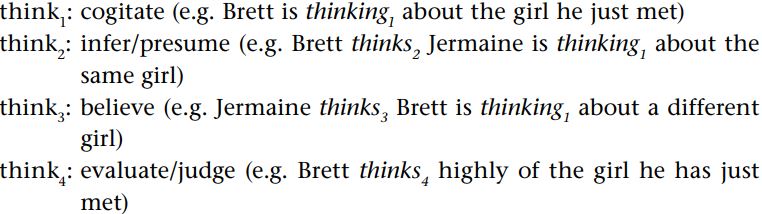
Such metalanguage, in English at least, directs us towards an account of Brett and Jermaine’s thinking as distinct and separate from what they might be feeling, but this is not a distinction that is necessarily as salient across all languages. It is apparent, then, that metapragmatics not only involves the study of reflexive awareness on the part of participants in relation to their use of language in interacting and communicating with others, but it also involves an analysis of the metalanguage those participants inevitably draw upon.
Thus, what we mean by metapragmatics is that it concerns the use of language on the part of ordinary users or observers, which reflects awareness on their part about the various ways in which we can use language to interact and communicate with others. It is worth briefly noting that the term metapragmatics itself was initially coined by Michael Silverstein (1976, 1993), a linguistic anthropologist, who drew, in turn, from work by the linguist Roman Jakobson (1971) on the metalingual function of language, which refers to the ways in which we can use language to “explain, gloss, comment on, predicate about or refer to propositional meaning” (Hübler and Bublitz 2007: 2).
However, while Jakobson was focused more narrowly on how language can be used to help participants to understand what the speaker is meaning in light of what has been said, Silverstein took a much broader view, as he defines metapragmatics as awareness that helps users to discern the relationship between linguistic forms and situated contexts (which is what allows the use of language in interaction to be an ordered, interpretable event). Metapragmatics in the broad sense advocated by Silverstein is essentially about anchoring linguistic (and non-linguistic) forms to contexts, a point we have largely covered. Metapragmatics in the narrower, more focused sense of Jakobson, in contrast, is concerned with the use of language that reflects reflexive awareness on the part of users about their use of language. In other words, metapragmatics involves the study of “the language user’s reflexive awareness of what is involved in a usage event” (Verschueren [1995] 2010: 1), including choices they have made in producing and interpreting talk or discourse. It thus generally encompasses the study of pragmatic indicators of this kind of reflexive awareness, and the communicative purposes to which these metapragmatic indicators are put. It is this latter, more focused sense of metapragmatics that we explore further.








