0
EN
1
المرجع الالكتروني للمعلوماتية

Grammar

Tenses

Present

Present Simple

Present Continuous

Present Perfect

Present Perfect Continuous

Past

Past Simple

Past Continuous

Past Perfect

Past Perfect Continuous

Future

Future Simple

Future Continuous

Future Perfect

Future Perfect Continuous

Parts Of Speech

Nouns

Countable and uncountable nouns

Verbal nouns

Singular and Plural nouns

Proper nouns

Nouns gender

Nouns definition

Concrete nouns

Abstract nouns

Common nouns

Collective nouns

Definition Of Nouns

Animate and Inanimate nouns

Nouns

Verbs

Stative and dynamic verbs

Finite and nonfinite verbs

To be verbs

Transitive and intransitive verbs

Auxiliary verbs

Modal verbs

Regular and irregular verbs

Action verbs

Verbs

Adverbs

Relative adverbs

Interrogative adverbs

Adverbs of time

Adverbs of place

Adverbs of reason

Adverbs of quantity

Adverbs of manner

Adverbs of frequency

Adverbs of affirmation

Adverbs

Adjectives

Quantitative adjective

Proper adjective

Possessive adjective

Numeral adjective

Interrogative adjective

Distributive adjective

Descriptive adjective

Demonstrative adjective

Pronouns

Subject pronoun

Relative pronoun

Reflexive pronoun

Reciprocal pronoun

Possessive pronoun

Personal pronoun

Interrogative pronoun

Indefinite pronoun

Emphatic pronoun

Distributive pronoun

Demonstrative pronoun

Pronouns

Pre Position

Preposition by function

Time preposition

Reason preposition

Possession preposition

Place preposition

Phrases preposition

Origin preposition

Measure preposition

Direction preposition

Contrast preposition

Agent preposition

Preposition by construction

Simple preposition

Phrase preposition

Double preposition

Compound preposition

prepositions

Conjunctions

Subordinating conjunction

Correlative conjunction

Coordinating conjunction

Conjunctive adverbs

conjunctions

Interjections

Express calling interjection

Phrases

Sentences

Clauses

Part of Speech

Grammar Rules

Passive and Active

Preference

Requests and offers

wishes

Be used to

Some and any

Could have done

Describing people

Giving advices

Possession

Comparative and superlative

Giving Reason

Making Suggestions

Apologizing

Forming questions

Since and for

Directions

Obligation

Adverbials

invitation

Articles

Imaginary condition

Zero conditional

First conditional

Second conditional

Third conditional

Reported speech

Demonstratives

Determiners

Direct and Indirect speech

Linguistics

Phonetics

Phonology

Linguistics fields

Syntax

Morphology

Semantics

pragmatics

History

Writing

Grammar

Phonetics and Phonology

Semiotics

Reading Comprehension

Elementary

Intermediate

Advanced

Teaching Methods

Teaching Strategies

Assessment

قم بتسجيل الدخول اولاً لكي يتسنى لك الاعجاب والتعليق.

Reflection: What are you inferring?

المؤلف:  Jonathan Culpeper and Michael Haugh

المصدر:  Pragmatics and the English Language

الجزء والصفحة:  120-5

9-5-2022

1108

+

-

20

Reflection: What are you inferring?

Consider the following conversation from an episode of The Simpsons.
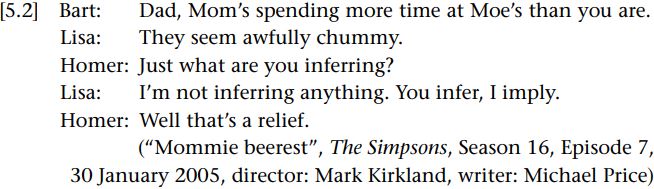
In this example, Bart and Lisa can be understood to be implying that Marge (Homer’s wife) might be having an affair with Moe. This latter proposition counts as an implicature, and it is drawn through a process of inference. Homer, being Homer, next commits the classic mistake of conflating implicature with inference, to which Lisa responds with the well-worn dictum that speakers imply, while hearers infer. Disputes about the distinction between implicature and inference, however, are not restricted to popular discourse. Horn (2004) and Bach (2006), for instance, contend that treating implicature and inference as synonymous constitutes a conceptual and analytical error.

However, there is reason to suspect that Homer may not be entirely wrong in inadvertently mixing up what is implied with what is inferred. First, infer has been used for almost five centuries in the sense of “imply” or “convey” (Horn 2012). Consider the following examples taken from the Oxford English Dictionary Online (2013):
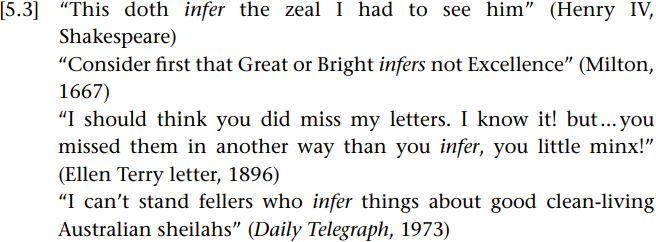
In all of the examples above, infer is used in the sense of “to involve as a consequence” or “to imply”. Second, his claim that Lisa (and Bart) are inferring something here is actually quite correct. They have both inferred from their mother’s recent behavior (e.g. spending a lot of time with Moe, getting on very well with Moe, and so on), along with real-world knowledge about how affairs involving married partners normally arise, that she might be having an affair with Moe. Moreover, they have also presumably inferred that, if they raise this behavior with their father, Homer might come to the same conclusion about the possible implications of Marge’s behavior. Everyone makes inferences, not just hearers. The distinction between imply (cf. implicature) and infer (cf. inference) therefore does not in itself help us distinguish between the speaker’s and hearer’s perspectives on speaker meaning.

Kecskes (2010) argues, however, that a hearer-centred account of pragmatic meaning neglects the speaker’s own perspective, which is perhaps somewhat ironic considering the Gricean roots from which such accounts have sprung. Following Saul’s (2002a) distinction between utterer and audience implicature, one solution to this might be that we must necessarily talk about utterer and recipient representations of speaker meaning. An utterer representation of speaker meaning is what the speaker understands he or she has meant through his or her own utterance. A recipient representation of speaker meaning is what the hearer(s) or other kinds of participants understand the speaker to have meant through his or her utterance. In this way, we can properly recognize, rather than confound, distinct perspectives on speaker meaning.


اخر الاخبار

اشترك بقناتنا على التلجرام ليصلك كل ما هو جديد

