الوضع الليلي


 2:18:48
 2026-09-09
 1013
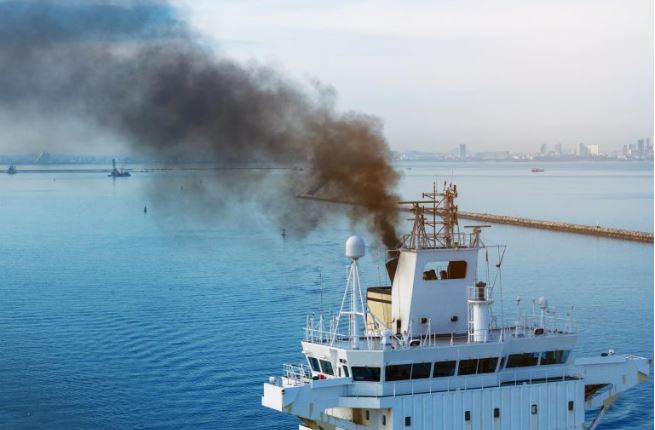
Carbon released by the Industrial Revolution has left a chemical fingerprint nearly everywhere scientists looked in the North Atlantic, including waters thousands of feet below the surface.
Scientists have traced carbon from fossil fuel emissions deep into the North Atlantic by measuring shifts in the natural balance between the isotopes C-12 and C-13, revealing how industrial activity is changing water masses far below the ocean surface.
When coal, oil, and natural gas are burned, their carbon enters the atmosphere and lowers the ratio of C-13 to C-12. This change, known as the Suess effect, gives scientists a way to distinguish carbon from fossil fuels from much of the carbon already circulating naturally through the planet.
Industrial Carbon Reaches the Deep Ocean
The ocean absorbs carbon dioxide as its surface exchanges gases with the atmosphere. Currents, vertical mixing, and the formation of deep water can then transport that carbon into the ocean interior, where it may remain separated from the atmosphere for decades or centuries.
To determine how far the industrial signature has traveled, Emma Bavoux and her colleagues analyzed carbon isotope ratios in North Atlantic water samples. The samples were collected aboard the research vessel MARIA S. MERIAN during expeditions in 2017 and 2018 along a route near 48° North that crossed the entire ocean basin.
The study, published in Geophysical Research Letters, also incorporated earlier measurements of sulfur hexafluoride (SF₆). Because this trace gas is produced by human activities and enters the ocean from the atmosphere, it can help researchers estimate when water was last exposed to the surface and calculate the human contribution to its carbon isotope signature.
A Chemical Clock for Ocean Water
“We were surprised by how significant the Suess effect already is in the deep-water masses of the North Atlantic,” says Emma Bavoux. The researchers detected the signal in nearly every water mass they examined, although its strength varied according to how recently the water had contacted the atmosphere.
Young subsurface waters carried the clearest evidence of fossil fuel carbon. The signal was extremely weak or absent in ancient water masses such as Northeast Atlantic Deep Water, which probably has remained isolated from the atmosphere for several hundred years.
Western North Atlantic waters showed a different pattern. Labrador Sea water and currents passing through the Denmark Strait before sinking into the deep ocean displayed Suess effect changes of about 0.3 to 0.6 per mile compared with preindustrial conditions. The team also tracked a large eddy in the Labrador Sea that carried a recognizable industrial carbon signature to depths of 2,000 meters (6,562 feet).
Human Activity Enters the Geological Record
The findings show that industrial emissions are altering not only the atmosphere and surface ocean, but also remote water masses far below. The same chemical shift is being preserved in the shells of foraminifera, microscopic marine organisms whose remains have accumulated on the seafloor during recent decades.
Because foraminifera build their shells using carbon from the surrounding seawater, their fossils can record changes in ocean chemistry. Successive layers of sediment may therefore preserve the rise of fossil fuel emissions as a measurable marker for future geologists.
“Through the Suess effect, the ocean floor preserves signals of human origin that now mark the beginning of the Anthropocene in these long-term geological archives,” says Stefan Mulitza, co-author of the study. “How clearly this stratigraphic boundary will be defined depends primarily on the future trajectory of carbon dioxide emissions.”
Scientists participating in the Cluster of Excellence “The Ocean Floor—Earth’s Uncharted Interface” are continuing to investigate how the ocean, its ecosystems, and the seafloor shape the global carbon cycle.
Reality Of Islam |
|

By filling

Scientists

A simple ch

Researchers
 9:3:43
2018-11-05
10 benefits of Marriage in Islam
7:5:22
2019-04-08
benefits of reciting surat yunus, hud &
9:45:7
2018-12-24
advantages & disadvantages of divorce
11:35:12
2018-06-10
6:0:51
2018-10-16
4:25:57
2023-02-11
3:43:50
2022-11-05
4:2:19
2022-10-10
2:11:12
2022-10-15
9:39:36
2022-12-28
6:0:8
2023-03-19
7:26:19
2022-04-08
5:41:46
2023-03-18
| LATEST |
 HOME