الوضع الليلي


 2:14:55
 2026-09-01
 846
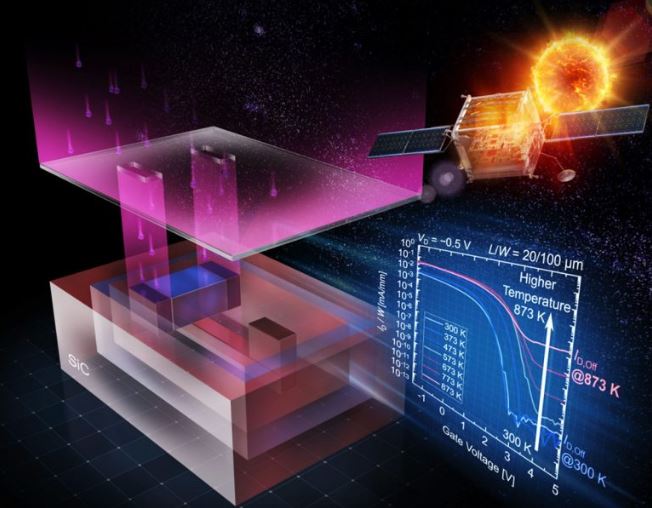
For more than 20 years, silicon carbide – SiC – has been viewed as a promising material for electronics that must function in extreme environments. Yet despite years of research, that promise has rarely translated into practical devices. Researchers at Kyoto University are now trying to move the field beyond that barrier.
“We believe the lack of development is because the research community has been trying to apply silicon-era thinking to a fundamentally different material,” says first author Mitsuaki Kaneko.
Conventional designs limited SiC performance
The researchers focused on junction field-effect transistors, or JFETs. Earlier work suggested that complementary circuits built from SiC JFETs could provide low-power integrated electronics capable of operating under extreme conditions.
But the group’s previous JFETs, which used conventional top-gate structures fabricated in semi-insulating SiC substrates, had two major shortcomings: poor controllability and substantial leakage current at high temperatures. Solving both problems was considered essential for practical applications.
“Our goal is to open a new path forward with complementary JFETs designed to harness the intrinsic properties of SiC itself,” says Kaneko.
Instead of creating an entirely new manufacturing process, the researchers used industry-standard fabrication methods. They adopted a bottom-gate structure to improve control over the transistor’s threshold voltage and replaced the semi-insulating substrate approach with well-based isolation to reduce leakage current at high temperatures.
The transistor operated at 600°C
The redesigned SiC transistor worked on the team’s first attempt. Testing showed that the device could continue operating at 600°C. The bottom-gate architecture substantially improved threshold voltage control and sharply lowered leakage current to a level close to the theoretical limit expected from the intrinsic properties of SiC.
The results show that SiC is already a mature power device material and highlight the potential of the new bottom-gate structure for building reliable SiC-based integrated circuits capable of operating at extreme temperatures.
Significant challenges remain before the technology can be used in practical systems. The researchers plan to develop more complex circuits, expand fabrication to wafer-level production, and ensure that complete device packages can withstand extreme environments.
Reality Of Islam |
|

By filling

Scientists

A simple ch

Researchers
 9:3:43
2018-11-05
10 benefits of Marriage in Islam
7:5:22
2019-04-08
benefits of reciting surat yunus, hud &
9:45:7
2018-12-24
advantages & disadvantages of divorce
11:35:12
2018-06-10
6:0:51
2018-10-16
bahlool & the throne of haroun rashid
8:20:35
2018-06-21
8:3:0
2018-06-21
9:50:37
2023-02-28
9:30:2
2021-11-12
6:14:17
2018-06-21
a hero waters thirsty wild animals
9:4:9
2022-01-06
5:57:34
2023-03-18
5:41:46
2023-03-18
| LATEST |
 HOME