الوضع الليلي


 3:3:54
  2025-07-05
  2032
2032
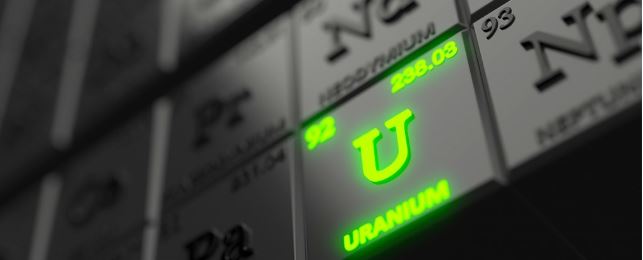
When most people hear the word uranium, they think of mushroom clouds, Cold War standoffs or the glowing green rods from science fiction.
But uranium isn't just fuel for apocalyptic fears. It's also a surprisingly common element that plays a crucial role in modern energy, medicine, and geopolitics.
What is uranium?
Uranium holds the 92nd position on the periodic table, and it is a radioactive, metallic element. Radioactivity is a natural process where some atoms – like uranium, thorium and radium – break down on their own, releasing energy.
The German chemist Martin Heinrich Klaproth initially identified uranium in 1789, and he named it after the newly discovered planet Uranus. However, its power was not unlocked until the 20th century, when scientists discovered that uranium atoms could split via a process known as nuclear fission.
In fission, the nucleus of the atom splits into two or more nuclei, which releases large amounts of energy.
Uranium is found almost everywhere. It is in rocks, soil and water. There are even traces of uranium in plants and animals – albeit tiny amounts. Most of it is found in the Earth's crust, where it is mined and concentrated to increase the amount of its most useful radioactive form, uranium-235.
The enrichment dilemma
Uranium-235 is an isotope of uranium, which is a version of an element that has the same basic identity but weighs a little more or less. Think about apples from the same tree. Some are big and some are small, but they are all apples – even though they have slightly different weights. Basically, an isotope is the same element but with a different mass.
Unprocessed uranium is mostly uranium-238. It only contains approximately 0.7% uranium-235, the isotope that allows the most nuclear fission to occur. So, the enrichment process concentrates uranium-235.
Enrichment can make uranium more useful for the development of nuclear weapons, since natural uranium doesn't have enough uranium-235 to work well in reactors or weapons. The process usually contains three steps.
The first step is to convert the uranium into a gas, called uranium hexafluoride. In the second step, the gas gets funneled into a machine called a centrifuge that spins very fast. Because uranium-235 is a little lighter than uranium-238, it moves outward more slowly when spun, and the two isotopes separate.
It's sort of like how a salad spinner separates water from lettuce. One spin doesn't make much of a difference, so the gas is spun through many centrifuges in a row until the uranium-235 is concentrated.
Uranium can typically power nuclear plants and generate electricity when it is 3%-5% enriched, meaning 3%-5% of the uranium is uranium-235. At 20% enriched, uranium-235 is considered highly enriched uranium, and 90% or higher is known as weapons-grade uranium.
This high grade works in nuclear weapons because it can sustain a fast, uncontrolled chain reaction, which releases a large amount of energy compared with the other isotopes.
Uranium's varied powers
While many headlines focus on uranium's military potential, this element also plays a vital role in modern life. At low enrichment levels, uranium powers nearly 10% of the world’s electricity.
In the US, many nuclear power plants run on uranium fuel, producing carbon-free energy. In addition, some cancer therapies and diagnostic imaging technologies harness uranium to treat diseases.
In naval technology, nuclear-powered submarines and aircraft carriers rely on enriched uranium to operate silently and efficiently for years.
Uranium is a story of duality. It is a mineral pulled from ancient rocks that can light up a city or wipe one off the map. It's not just a relic of the Cold War or science fiction. It's real, it's powerful, and it's shaping our world – from global conflicts to cancer clinics, from the energy grid to international diplomacy.
In the end, the real power is not just in the energy released from the element. It is in how people choose to use it.
Reality Of Islam |
|
A new gener
Building a
Now in spac
NASA’
 9:3:43
2018-11-05
9:3:43
2018-11-05
10 benefits of Marriage in Islam
7:5:22
2019-04-08
benefits of reciting surat yunus, hud &
9:45:7
2018-12-24
advantages & disadvantages of divorce
11:35:12
2018-06-10
6:0:51
2018-10-16
11:34:48
2022-06-29
5:58:12
2021-12-18
6:14:3
2023-01-18
8:30:23
2022-03-03
8:4:21
2022-01-08
7:59:14
2018-06-21
3:43:50
2022-11-05
5:41:46
2023-03-18
| LATEST |
 HOME
HOME