
الوضع الليلي


 4:2:17
 2023-09-24
 1768
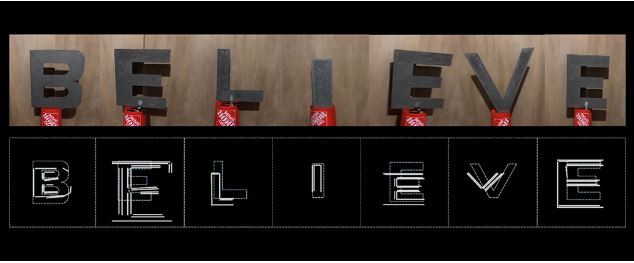
Wi-Fi signals can do much more than deliver streaming movies and music around the home, it turns out: they can also be used to identify shapes through solid walls, as demonstrated in recent experiments.
The ability for Wi-Fi to spot movement through walls has been shown off before, but the technology struggles with seeing anything that isn't in motion.
To overcome that limitation, researchers from the University of California Santa Barbara (UCSB) designed a Wi-Fi setup to concentrate specifically on the edges of objects, much like a person might do an outline drawing.
This approach meant that the researchers were able to use what's known as the Geometrical Theory of Diffraction (or GTD), which describes the behavior of waves as they hit the edges of objects – causing interference or diffractions in the waves.
In this case, the waves are Wi-Fi signals, which form shapes called Keller cones as they diffract around the edges of objects. By interpreting the composition and direction of these Keller cones, a scene can gradually be revealed.
"We then develop a mathematical framework that uses these conic footprints as signatures to infer the orientation of the edges, thus creating an edge map of the scene," says electrical and computer engineer Yasamin Mostofi, from UCSB.
Called Wiffract, the setup put together by Mostofi and his colleagues involves three Wi-Fi transmitters to send out signals and a roving receiver to catch them as they bounce around.
We know Wi-Fi waves can go through walls – your router would be pretty useless if it didn't – but these waves are also affected as they strike objects.
Some complex math (and educated guesswork) is then required to determine the shapes that correspond with the Keller cones. Using data from edges that have a strong reading, the scientists were able to improve the system's ability to detect edges with a weaker reading, perhaps further away from the transmitters or in a concealed spot.
"Once we find the high-confidence edge points via the proposed imaging kernel, we then propagate their information to the rest of the points using Bayesian information propagation," says electrical engineer Anurag Pallaprolu, from UC Santa Barbara.
The statistical number-crunching involved in Bayesian information propagation is not unlike working on a jigsaw puzzle: if you're sure about the position of some pieces, you may be able to figure out the position and shape of the pieces needed to fill the gaps.
A lot of fine-tuning is still required, but the system can already recognize large letters. Ultimately, it could be used anywhere from disaster rescue to smart home monitoring, 'seeing' inside rooms when there's no line of sight.
Reality Of Islam |
|

By filling

Scientists

A simple ch

Researchers
 9:3:43
2018-11-05
10 benefits of Marriage in Islam
7:5:22
2019-04-08
benefits of reciting surat yunus, hud &
9:45:7
2018-12-24
advantages & disadvantages of divorce
11:35:12
2018-06-10
6:0:51
2018-10-16
3:43:50
2022-11-05
9:50:37
2023-02-28
7:59:14
2018-06-21
6:28:21
2022-12-20
9:42:16
2022-10-19
allah will not answer all your prayers
6:56:28
2022-01-01
5:58:12
2021-12-18
5:41:46
2023-03-18
| LATEST |
 HOME






















