الوضع الليلي


 4:11:32
  2023-09-16
  1600
1600
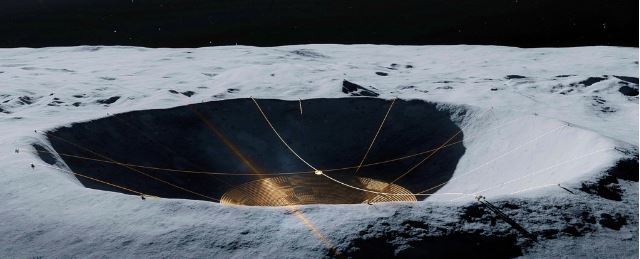
We have built telescopes in our backyards, and high upon remote mountains, and even launched telescopes into space.
With each advancement in our technology, we have made amazing and surprising new discoveries about the Universe. So what should our next advance in observatories be?
Based on a new paper on the arXiv, a good choice would be the lunar surface.
Placing telescopes on the moon is not a new idea. Already NASA has funded an exploratory grant for the Lunar Crater Radio Telescope (LCRT). During the Apollo missions, astronauts placed retroreflectors on the Moon so that astronomers could measure the distance to the moon within millimeters.
In this new paper, the authors summarize several known ideas and also introduce a new concept they call a hyper telescope.
While radio telescopes on the lunar far side such as LCRT are perhaps the most popular proposal, others include the Life Finder Telescope At Lunar Poles (LFTALP), which would be an array of 6.5-meter telescopes focused on studying exoplanet atmospheres as they transit their star.
Then there is the Lunar Optical UV Explorer (LOUVE), which focuses on bright ultraviolet objects. There are even proposals for a gravitational wave observatory similar to LIGO.
The problem with all of these proposals is that they will require construction at a technical level that would be a challenge even on Earth. The idea of building array observatories and the like on the Moon is a lofty goal, but it is currently far beyond our technical abilities.
So the authors propose a somewhat simpler idea. A basic optical telescope that would take advantage of the lunar terrain. The power of an optical telescope depends largely on the size of its primary mirror and the focal length of the telescope. On Earth, focal length can be increased by having multiple mirrors.
A hypertelescope could use a mirror array as the primary mirror arranged along the terrain of a crater. The detector cluster of the telescope could then be suspended by a cable, similar to the way the detectors of Arecibo Observatory were suspended above the mesh dish.
Since the mirrors wouldn't need to be large, they would be much easier to construct, and the general shape of the crater would mean less "earthworks" needed to put them in place.
A variant of this idea would be to place mirrors on one side of a crater, and the instrumentation on the other. This would allow for a very large focal length, the the observational range such such a telescope would be limited.
All of these ideas are still in their early stages. And there are serious challenges that would need to be overcome beyond their construction.
Dust would accumulate on the mirrors over time, and would need to be removed. And although the Moon has much less seismic activity than Earth, it could still affect the alignment of mirrors and detectors.
But one thing that's clear is that we will return to the Moon, and where humans go they build telescopes. A lunar observatory is only a matter of time.
Reality Of Islam |
|

A new gener
Building a
Now in spac
NASA’
 9:3:43
2018-11-05
9:3:43
2018-11-05
10 benefits of Marriage in Islam
7:5:22
2019-04-08
benefits of reciting surat yunus, hud &
9:45:7
2018-12-24
advantages & disadvantages of divorce
11:35:12
2018-06-10
6:0:51
2018-10-16
2:33:4
2023-02-15
2:5:14
2023-01-28
8:19:41
2018-06-21
8:15:37
2023-02-16
7:45:39
2018-06-21
5:58:12
2021-12-18
2:34:48
2022-01-18
5:41:46
2023-03-18
| LATEST |
 HOME
HOME