الوضع الليلي


 4:10:18
 2023-09-16
 1685
Parasites are understandably unpopular. Some cause horrible illnesses in their hosts, and even the less dangerous ones are often creepy or gross.
While they can be monsters, parasites aren't all bad. Many organisms benefit from species that survive by sucking the very life from others. Even their hosts might get a kickback or two.
Now a new study suggests some species can only survive in certain habitats if parasites are there, too.
Parasites come in many shapes and sizes, from viruses and amoebae to plants like mistletoe and animals like nematodes or mosquitoes. They all use a host for resources, which they typically harm but don't kill. As the late entomologist E.O. Wilson put it, parasites are "predators that eat prey in units of less than one."
Similar to the way predators can help regulate their overall ecosystem, parasites often provide overlooked ecological services that are only obvious in their absence.
In fact, according to zoologist Sigal Orlanski from Tel Aviv University, the horrors of individual parasitic infections belie the surprising value these creatures offer for their broader community.
"Parasites and pathogens are an integral part of any ecosystem," she says. "Despite their bad reputation, parasites play a key role in shaping population dynamics, community structure, and biodiversity, thanks to their influence on the balance between the species in that ecosystem."
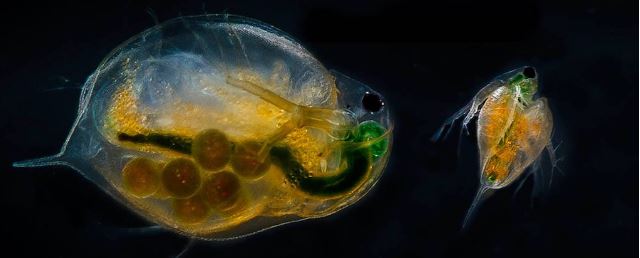
In a new study, Orlansky and co-author Frida Ben-Ami focused on how parasites influence populations of tiny crustaceans commonly called "water fleas," from the genus Daphnia.
Daphnia grow up to 5 millimeters long, inhabiting various freshwater habitats where they feed on single-celled algae, bacteria, and protists. In turn, they serve as a food source for other larger aquatic species, like fish, tadpoles, and insects.
Using two Daphnia species with differing levels of parasite resistance, the researchers tested how the presence of parasites affected an ecological phenomenon known as the comparative exclusion principle, or Gause's law, among the water fleas.
Biodiversity is a key feature of healthy ecosystems, Orlansky and Ben-Ami note, and related species can share space if their relationships with predators and natural resources are different enough.
According to Gause's law, however, two species with identical niches in the same habitat can't coexist indefinitely at constant levels. If they're too similar, even a small advantage can help one species dominate, leaving others to eventually die out or seek a different niche.
Most animals serve as hosts or carriers for parasites of some kind, and water fleas are no exception. It's rare to find a species with nearly total parasite resistance, yet the study did include one Daphnia species with an almost supernatural ability to withstand parasites.
"In the population of water fleas in Israel, we found one species called Daphnia similis, whose nickname in the laboratory is 'Super Daphnia' due to its almost complete resistance to parasites," Ben-Ami says.
"Nevertheless, this 'Super Daphnia' does not become the dominant Daphnia species in ponds," she adds. "The most common species is actually Daphnia magna, which is highly vulnerable to a wide variety of parasites."
To figure out why, the researchers simulated an ecosystem in the lab, placing the two Daphnia species together in habitats either with or without parasites.
In a habitat free of parasites, not only did the parasite-sensitive D. magna outcompete its parasite-resistant relative, the study found, but it was the only Daphnia left standing.
Things played out differently in habitats with parasites, however, where D. magna proved less dominant and Super Daphnia managed to establish a population and coexist with D. magna – thanks to a little help from parasites.
"The results of these experiments emphasize the important role of parasites in shaping biodiversity, as the parasites can mediate competition between Daphnia species," Orlansky says.
Although Super Daphnia excels at resisting parasites, its overall competitive ability still doesn't match that of D. magna, Orlansky adds, and without parasites it "would probably become extinct when it shares the same habitat."
"Our research shows that coexistence of these two Daphnia species is only possible through the mediation of a parasite," she says.
Reality Of Islam |
|

By filling

Scientists

A simple ch

Researchers
 9:3:43
2018-11-05
10 benefits of Marriage in Islam
7:5:22
2019-04-08
benefits of reciting surat yunus, hud &
9:45:7
2018-12-24
advantages & disadvantages of divorce
11:35:12
2018-06-10
6:0:51
2018-10-16
9:39:36
2022-12-28
9:42:16
2022-10-19
1:34:8
2022-02-01
3:43:50
2022-11-05
8:3:0
2018-06-21
1:38:41
2021-12-08
7:0:55
2022-05-17
5:41:46
2023-03-18
| LATEST |
 HOME