الوضع الليلي


 4:6:3
4:6:3  2023-08-07
  4303
4303
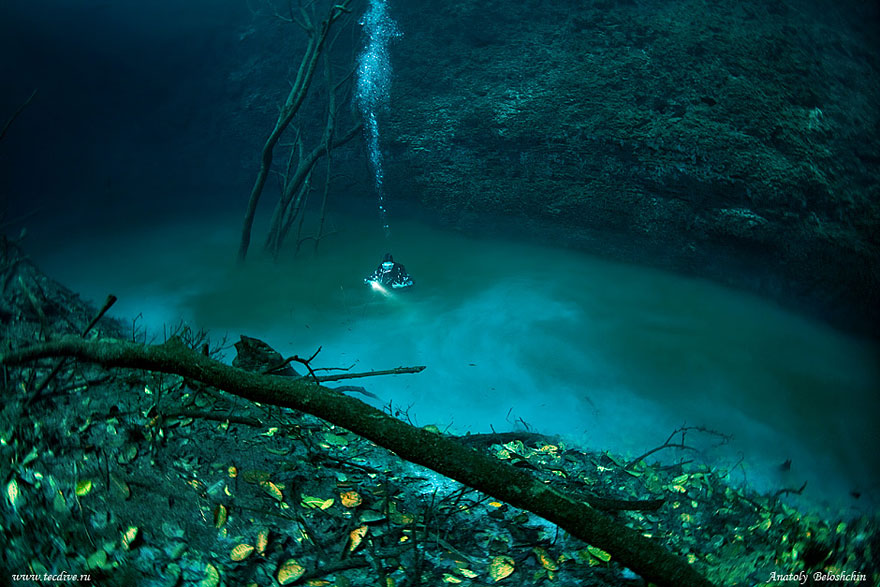
There’s an underwater river just below the cave at Cenote Angelita on the Yucatán Peninsula. It’s a pretty unique place. This cenote contains a thin layer of hydrogen sulfate that separates the salt water from the fresh water above. Thus, it looks like a river. Read on to find out more about this mysterious place.
What exactly is a cenote?
Cenotes are natural pits or deep sinkholes. They’re scattered throughout the Yucatán Peninsula. The result of the collapse of limestone bedrock exposed the water flows beneath.
Furthermore, “cenote” is the term used to describe a freshwater cave. It’s often used to define doline karst; a sinkhole phenomenon common in other parts of the world, especially in Central America. The ancient Maya believed that cenotes were sacred and used them for religious rites, including human sacrifice.
What is the underwater river of Cenote Angelita like?
Cenote Angelita has the appearance of a cavern where the bedrock has long since collapsed. It’s exceptional in the sense that it’s trapped salt water from the sea and fresh water from rainfall for fifty-five meters.
But, how can an underwater river flow through a cenote? Well, this amazing natural phenomenon is due to the presence of hydrogen sulfide, a chemical that’s heavier than salt water. The hydrogen sulfide ends up on the bottom of the river and forms a distinct layer. This is precisely what creates the illusion of an underwater river.
The Angelita river is over 300 feet deep and has several layers of alternating fresh and salt water. Adding to the beauty of the river is the colorful foliage and fallen branches of the trees nearby. They float on the banks of the river due to the water density.
Visiting this cave is no easy task. The water is clear for the first 60 feet and then gets murky. Immersion in the cave reaches a depth of about 170 feet. So, it’s only considered suitable for highly experienced divers.
Diving at the Cenote Angelita
Mexico’s mystical underwater river is certainly a worthwhile trip for those seeking unique and fascinating experiences. Again, you must be a qualified diver with at least 20 logged dives to go down.
Divers from all over the world come to Cenote Angelita and witness the unusual river deep inside a cenote.
A diver will first notice clear water, with no impurities or visible obstructions. But the vision becomes even more spectacular as they get further down. A river of greenish mist flows below the surface, along with the trees and branches on its banks.
The scene is like something out of a scary movie. Any diver might feel disoriented among the organic chemicals suspended in the halocline, due to changes in salinity. As we mentioned above, the hydrogen sulfide is what creates the layer of the mist that looks like a river. It attracts a lot of attention, and visitors.
Reality Of Islam |
|

A new gener

Building a
Now in spac
NASA’
 9:3:43
2018-11-05
9:3:43
2018-11-05
10 benefits of Marriage in Islam
7:5:22
2019-04-08
benefits of reciting surat yunus, hud &
9:45:7
2018-12-24
advantages & disadvantages of divorce
11:35:12
2018-06-10
6:0:51
2018-10-16
2:34:48
2022-01-18
6:14:3
2023-01-18
al-hussain (peace be upon him)
10:18:1
2022-09-21
3:42:22
2021-12-24
1:34:8
2022-02-01
8:19:41
2018-06-21
2:42:26
2023-02-02
5:41:46
2023-03-18
| LATEST |
 HOME
HOME