الوضع الليلي


 12:28:46
  2023-06-18
  2410
2410
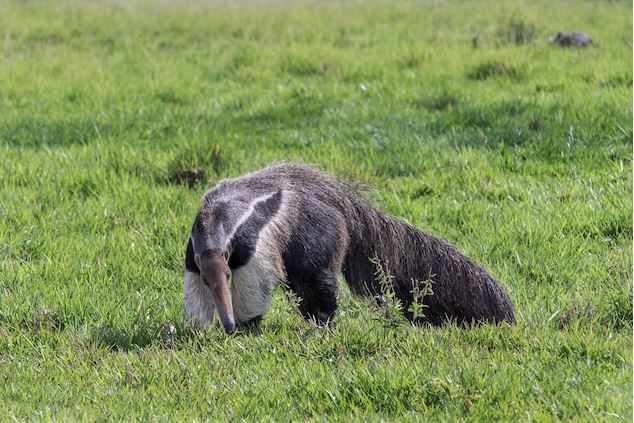
Anteaters are edentate animals—they have no teeth. But their long tongues are more than sufficient to lap up the 35,000 ants and termites they swallow whole each day. As the largest of all four anteater species, the giant anteater can reach eight feet long from the tip of its snout to the end of its tail. It is covered in grayish brown fur with white front legs, black stripes running from its chest to its back, and a bushy tail.
Habitat
Giant anteaters can be found throughout South and Central America, though their numbers have diminished considerably from the latter. To thrive, they need to be able to move throughout large areas with patches of forest. They can often be found in tropical and dry forests, savannas, and open grasslands, where the ants upon which they feed are abundant.
The giant anteater uses its sharp claws to tear an opening into an anthill and put its long snout, sticky saliva, and efficient tongue to work. But it has to eat quickly, flicking its tongue up to 150 times per minute. Ants fight back with painful stings, so an anteater may spend only a minute feasting on each mound. Giant anteaters never destroy a nest, preferring to return and feed again in the future.
These animals find their quarry not by sight—theirs is poor—but by their sense of smell, which is 40 times more powerful than that of a human.
Giant anteaters are generally solitary animals. Females have a single offspring once a year, which can sometimes be seen riding on its mother's back. Pups leave their mother after two years, when they’re considered fully grown.
Anteaters are not aggressive, but they can be fierce. A cornered anteater will rear up on its hind legs, using its tail for balance, and lash out with dangerous claws. The giant anteater's claws are some four inches long, and the animal can fight off even a puma or jaguar.
According to the IUCN Red List, giant anteaters are the most threatened mammals in Central America. Listed as a vulnerable species, they are considered extinct in Guatemala, El Salvador, and Uruguay. One of the major threats giant anteaters face is the loss of their grassland habitats due to fires set by sugar cane growers who traditionally burn their fields prior to harvest to remove the plant’s outer leaves, making the cane stalks easier to cut. Not only do these fires affect the habitat, but also the animals—giant anteaters may suffer significant burns.
Other threats include hunting—both for food and because some humans consider giant anteaters pests—and their low reproductive rate. Giant anteaters are also frequently killed by road traffic in the Brazilian Cerrado biome, where a vast network of roads has disrupted their habitat.
In Argentina, the Iberá Project has rescued more than a hundred orphaned anteaters and reintroduced them to the wild. In Brazil, burning sugar cane is slowly being is slowly being phased out in some parts of the country, while conservationists—including National Geographic Photo Ark EDGE Fellow Vinicius Alberici-are working in the Cerrado Biome to collect data on how roadways affect giant anteaters in hopes to set new protections.
Reality Of Islam |
|

A new gener

Building a

Now in spac

NASA’
 9:3:43
2018-11-05
9:3:43
2018-11-05
10 benefits of Marriage in Islam
7:5:22
2019-04-08
benefits of reciting surat yunus, hud &
9:45:7
2018-12-24
advantages & disadvantages of divorce
11:35:12
2018-06-10
6:0:51
2018-10-16
8:30:23
2022-03-03
6:0:8
2023-03-19
bahlool & the throne of haroun rashid
8:20:35
2018-06-21
allah will not answer all your prayers
6:56:28
2022-01-01
9:50:37
2023-02-28
8:39:51
2022-09-23
4:26:43
2022-02-21
5:41:46
2023-03-18
| LATEST |
 HOME
HOME