الوضع الليلي


 3:55:33
 2023-06-08
 2112
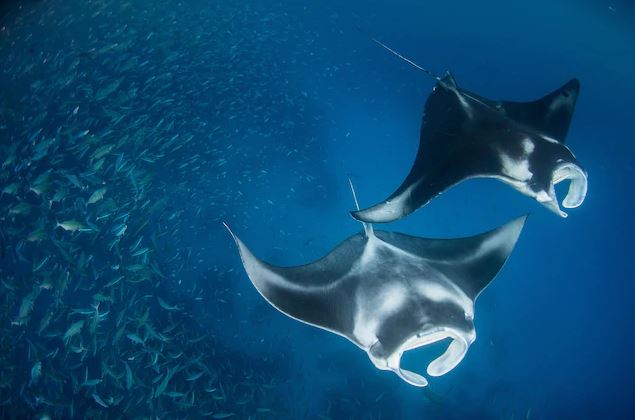
Manta rays—highly intelligent and highly threatened—are the largest rays in the world.
The sea creatures live in tropical, subtropical, and temperate ocean waters across the globe. “Manta” means blanket or cloak in Spanish, describing the look of the animals’ large, flat, diamond-shaped bodies, which are characterized by triangular pectoral fins. Manta rays have two horn-shaped fins protruding from the front of their heads, which has also given them the nickname “devil fish.”
For decades, scientists thought there was just one species of manta ray. In 2008, researchers discovered that there are actually two distinct species: the reef manta ray, which tends to live along coastlines in the Indo-Pacific, and the giant oceanic manta ray, which lives in all the world’s major oceans, spending most of its life far from land.
While the smaller reef manta has an impressive wingspan of about 11 feet wide on average, the giant oceanic manta ray—the largest species of ray—can have a wingspan of up to 29 feet.
Both species of manta ray are filter feeders: they swim with their mouths wide open, drawing in zooplankton and krill, which they sift through rows of tiny rakes that line their mouths called gill plates. They use creative techniques when feeding, often doing repeated somersaults to stay in a single spot that is packed with krill, or chain-feeding—following each other in a circle, mouths open, to create a cyclone effect, trapping food in a spiral.
Giant manta rays live alone or in small groups, typically congregating to feed. They’re considered predators and hunt deep below the surface of the sea.
Manta rays make regular visits to cleaning stations—spots on a coral reef where sea animals go to be cleaned by smaller creatures—where they stay still for several minutes while cleaner fish remove parasites and dead skin. Many individual manta rays return to the same station over and over.
Manta rays have the largest brain-to-size ratio of any cold-blooded fish. Studies have shown that manta rays may recognize themselves in the mirror, an ability indicative of high cognitive function, also shown by dolphins, primates, and elephants.
Studies have also shown that manta rays are able to create mental maps of their environment, through smell and visual cues, indicating highly developed long-term memory.
Female manta rays hit sexual maturity at around eight to 10 years old and tend to give birth once every couple of years, usually to one pup, or occasionally two. Pregnancy lasts about 12 to 13 months and manta rays give birth to live pups. Babies look like smaller version of adult manta rays when born and can immediately survive without parental care. Manta rays can live for 50 years.
Reality Of Islam |
|

By filling

Scientists

A simple ch

Researchers
 9:3:43
2018-11-05
10 benefits of Marriage in Islam
7:5:22
2019-04-08
benefits of reciting surat yunus, hud &
9:45:7
2018-12-24
advantages & disadvantages of divorce
11:35:12
2018-06-10
6:0:51
2018-10-16
7:32:24
2022-02-14
3:43:50
2022-11-05
11:34:48
2022-06-29
6:0:8
2023-03-19
9:30:2
2021-11-12
6:14:17
2018-06-21
3:42:22
2021-12-24
5:41:46
2023-03-18
| LATEST |
 HOME