الوضع الليلي


 10:32:13
 2023-04-04
 3493
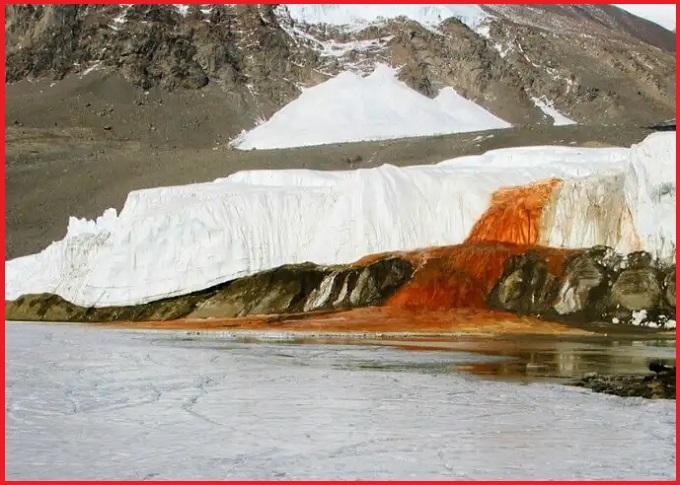
One of the world's most extreme deserts might be the last place one would expect to find a waterfall, but in Antarctica's McMurdo Dry Valley, a five-story fall pours slowly out of the Taylor Glacier into Lake Bonney. And it's not just the idea of a waterfall in the frozen world of Antarctica that is strange: the waterfall is bright red, like blood running from a cut in the glacier.
If you're squeamish, don't worry—it's not blood that lends Blood Falls its unique crimson hue. Five million years ago, sea levels rose, flooding East Antarctica and forming a salty lake. Millions of years later, glaciers formed on top of the lake, cutting it off from the rest of the continent—meaning that the water in Blood Falls is something of an aqueous time capsule, preserved 400 meters underground. As the glaciers on top of the lake began to freeze, the water below became even saltier. Today, the salt content of the subglacial lake under Blood Falls is three times saltier than seawater and too salty to freeze. The subglacial lake that feeds Blood Falls is trapped beneath a quarter mile of ice.
But in addition to being cut off from the rest of the continent, the water that feeds Blood Falls is completely cut off from the atmosphere—it has never seen sunlight and is completely devoid of oxygen. It's also extremely rich in iron, which was churned into the water by glaciers scraping the bedrock below the lake. When water from the subglacial lake seeps through a fissure in the glacier, the salty water cascades down the Taylor Glacier into Lake Bonney below. When the iron-rich water comes into contact with the air, it rusts—depositing blood red stains on the ice as it falls.
The color of Blood Falls isn't the only weird thing about it, however—it's what lives inside the subglacial lake that interests scientists more than the waterfall's creepy color. Millions of years ago, when those glaciers covered the salt lakes, there were microbes living in the water, and those microbes haven't gone anywhere, even though the water is now an extremely salty, oxygen-free bowl of complete darkness buried 400 meters under a glacier. Much like bacteria found living near deep sea thermal vents, the microbes of Blood Falls get their energy from breaking apart sulfates, which contain oxygen. After that, something eerily magical happens with the by-products—the iron in the water interacts with them to restore the sulfates, basically recycling the sulfates for the microbes to break down into oxygen over and over again.
Reality Of Islam |
|

By filling

Scientists

A simple ch

Researchers
 9:3:43
2018-11-05
10 benefits of Marriage in Islam
7:5:22
2019-04-08
benefits of reciting surat yunus, hud &
9:45:7
2018-12-24
advantages & disadvantages of divorce
11:35:12
2018-06-10
6:0:51
2018-10-16
bahlool & the throne of haroun rashid
8:20:35
2018-06-21
1:16:44
2018-05-14
6:0:8
2023-03-19
1:34:8
2022-02-01
6:14:17
2018-06-21
8:21:9
2018-06-21
11:34:48
2022-06-29
5:41:46
2023-03-18
| LATEST |
 HOME