الوضع الليلي


 4:50:24
  2019-08-04
  2005
2005
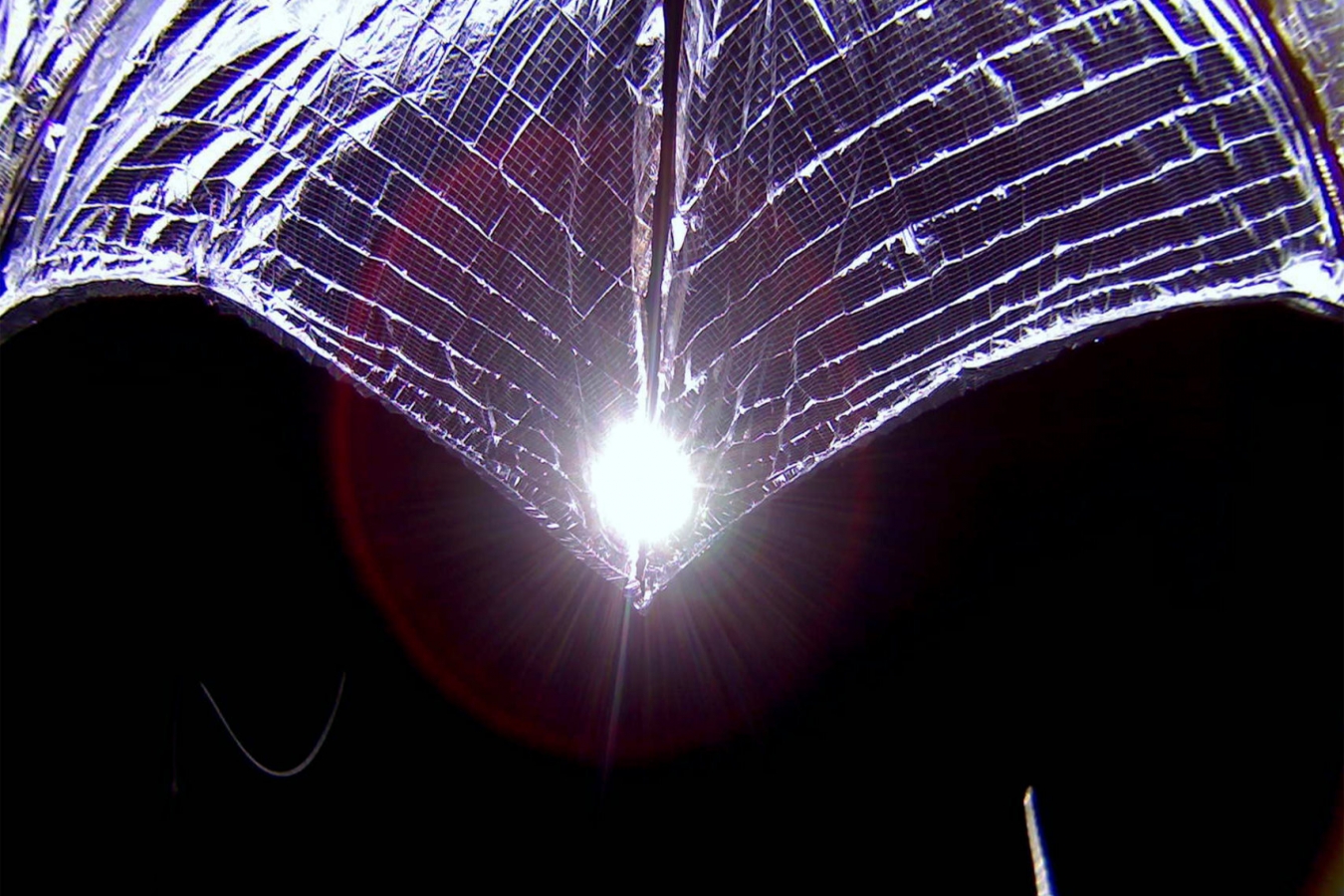
Mission accomplished: the Planetary Society announced Wednesday that its LightSail 2 spacecraft, which was launched last month, had successfully raised its orbit using only the power of photons from the Sun.
The team behind the $7 million crowd-funded venture said they had demonstrated a proof of concept for a new form of propulsion that could one day transform deep space exploration by doing away with the need for expensive rockets and fuel.
"In the past four days the spacecraft has raised its apogee, or orbital high point, by about 1.7 kilometres (one mile) attributable to solar sailing," said Bruce Betts, LightSail 2 program manager.
That makes it the first spacecraft to use solar sailing for propulsion in Earth orbit, and the second-ever solar sail spacecraft to successfully fly, following Japan's IKAROS, which launched in 2010.
"This technology enables us to take things to extraordinary destinations in the solar system, and maybe even beyond, in a way that's never been possible because you don't need fuel and you don't need all the systems to control fuel," said Bill Nye, the chief executive of the Planetary Society.
He added he would like to see the technology applied to missions searching for life on Mars, Jupiter's moon Europa, and Saturn's moon Titan, and "solar sails could enable you to lower the cost of these missions."
Another application could be in maintaining a probe at a stationary point in space, such as a telescope that looks out for asteroids in the vicinity of Earth, or a satellite that needs to be fixed in a stationary orbit above the North Pole.
The idea of solar sailing was first theorized in the 1600s by Johannes Kepler, who wrote that sails and ships "could be adapted to heavenly breezes."
LightSail 2 puts that into practice via a sail made from Mylar that unfurls to a size of 32 square meters (yards).
As packets of light energy known as photons bounce off the sail, they transfer their momentum in the opposite direction, pushing the vessel along with a thrust that is tiny but unlimited.
With no friction in the near-vacuum of space, the vessel will eventually achieve incredibly high speeds.
The parallels to ocean sailing don't stop there: as it flies to the Sun, the sail orients itself edge-on, effectively turning off its thrust. When flying away from the Sun, the sail turns broadside to the photons, getting a slight push.
LightSail 2, which is controlled autonomously via software, does not have the precision to maintain a circular orbit.
Therefore as its apogee rises, its perigee, or orbital low point, decreases, exposing it to atmospheric drag that will overcome the thrust from solar sailing. LightSail 2 will continue to orbit for about a year before falling back into Earth's atmosphere.
Reality Of Islam |
|
A new gener
Building a
Now in spac
NASA’
 9:3:43
2018-11-05
9:3:43
2018-11-05
10 benefits of Marriage in Islam
7:5:22
2019-04-08
benefits of reciting surat yunus, hud &
9:45:7
2018-12-24
advantages & disadvantages of divorce
11:35:12
2018-06-10
6:0:51
2018-10-16
5:57:34
2023-03-18
9:42:16
2022-10-19
10:47:11
2022-11-22
3:18:29
2022-12-24
a hero waters thirsty wild animals
9:4:9
2022-01-06
4:2:19
2022-10-10
7:34:7
2023-02-28
5:41:46
2023-03-18
| LATEST |
 HOME
HOME